Five thousand years
From the world's first planned cities on the banks of the Indus, through ten Gurus who reshaped a civilisation, to an empire that closed the Khyber Pass and a partition that scattered millions across the earth, this is the whole thread of Punjab's story, era by era.
Watch
Seven minutes, from Guru Nanak Dev Ji to the annexation of Punjab, told with maps.
In the beginning
Long before empires, before Gurus, before borders, Punjab was already home to the most advanced civilisation on Earth.
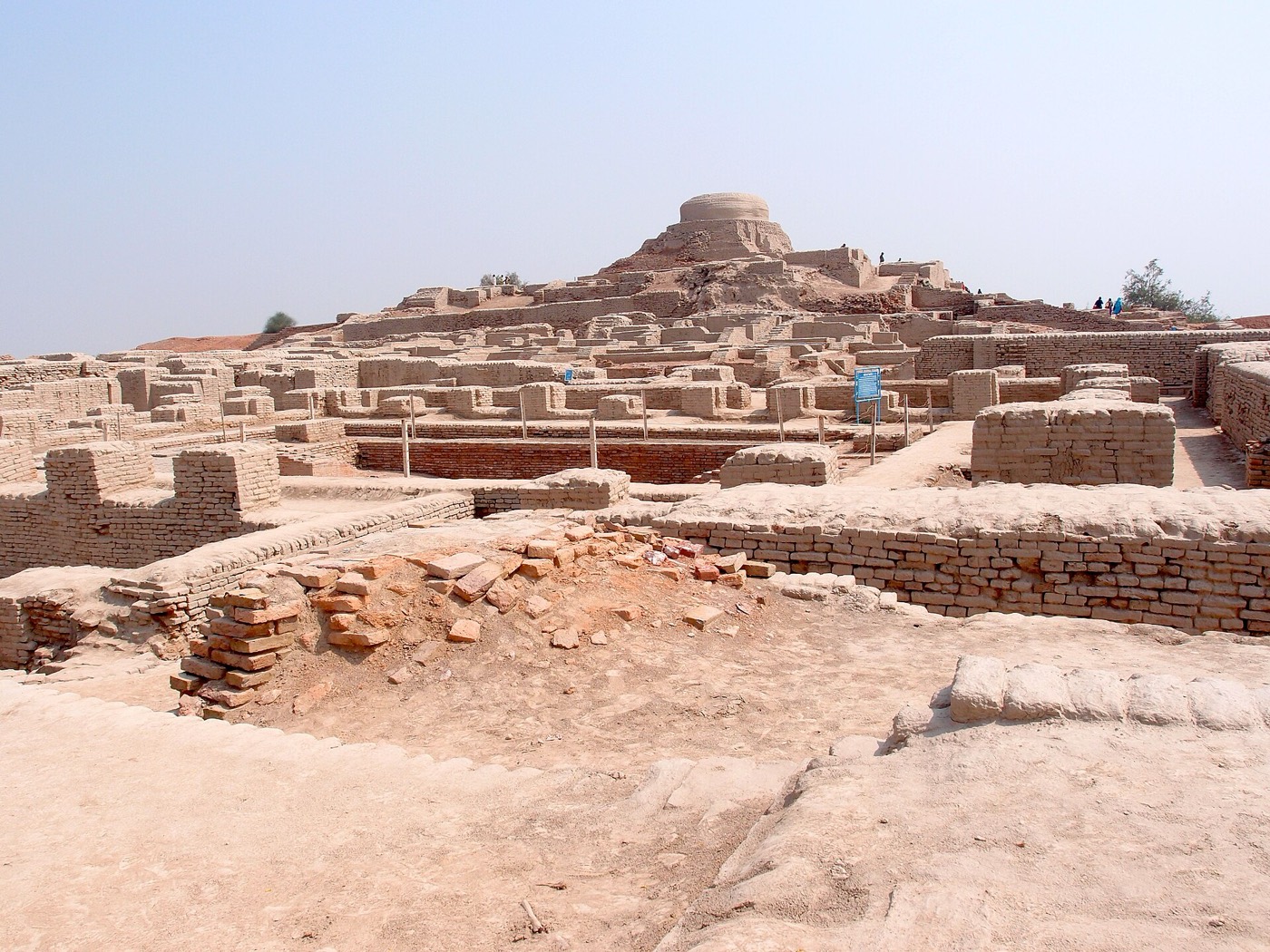
Harappa and Mohenjo-daro rose in the Punjab and Sindh region, the world's first planned cities. Running water, covered drainage, standardised bricks used across thousands of kilometres, and trade routes reaching as far as Mesopotamia. At the time, nothing on Earth was more advanced.
Harappa itself sits in what is now Punjab, Pakistan, and gave the whole civilisation its name. Its script has never been deciphered, and archaeologists have found no palaces, temples or grand tombs, evidence, many scholars believe, of a society organised around trade and craft guilds rather than kings and priests.
At Mohenjo-daro, engineers built the Great Bath, a watertight civic pool roughly 12 by 7 metres, sealed with bitumen and fed by its own well, likely used for ritual bathing centuries before any comparable structure existed elsewhere. City blocks were laid out on a grid, houses had private wells and bathrooms, and waste flowed away through covered brick drains, a level of sanitation most of the world would not see again for millennia. Bricks everywhere, from Punjab to Gujarat, were fired to the same 1:2:4 ratio, and a shell scale found at Mohenjo-daro divided into eight equal segments points to a shared, decimal system of weights and measurement used across the whole civilisation.
That reach was matched by its trade. Sumerian tablets in Mesopotamia refer to a distant land called Meluhha, most scholars agree, the Indus Valley itself, source of the carnelian beads, ivory, cotton and timber that Indus seals, unearthed as far away as Ur and Kish, once accompanied. In return, the Indus cities imported lapis lazuli from Afghanistan and copper from Oman and Rajasthan, a trading network stretching thousands of kilometres with no visible army or monument to enforce it.
The civilisation faded gradually after 1900 BCE, most likely as the Ghaggar-Hakra river system dried and monsoon patterns shifted, rather than through conquest or catastrophe. Rakhigarhi, in modern Haryana, has since proven larger than either Harappa or Mohenjo-daro, over 350 hectares, and excavations there continue to reshape what is known. It matters to Punjab specifically because Harappa, the civilisation's namesake city, sits on Punjabi soil: the story of South Asian civilisation itself begins here, three thousand years before a single Guru, empire or invader ever crossed the Indus.
The Rig Veda, one of humanity's oldest surviving texts, was composed in the Punjab region. The name itself comes from Persian: panj (five) and ab (water), Land of Five Rivers: the Jhelum, Chenab, Ravi, Beas and Sutlej.
Its 1,028 hymns, composed in early Sanskrit between roughly 1500 and 1200 BCE, were not written down for close to a thousand years. Instead they were preserved purely through memorised oral recitation, passed teacher to student with such exacting precision, including a system for checking every syllable, that scholars still regard the transmission as one of the most accurate acts of memory in human history.
The Rig Veda itself calls this land the Sapta Sindhu, the Land of Seven Rivers: the Indus and its five Punjab tributaries, plus the Sarasvati, a once-mighty river that scholars now believe corresponds to the dried Ghaggar-Hakra channel. The hymns describe a pastoral, cattle-herding society organised into clans and tribal kingdoms, fighting from horse-drawn chariots and worshipping a pantheon of gods, Indra, Agni and Varuna among them, that would evolve over the following centuries into classical Hinduism.
It matters because Punjab's very name and identity, a land defined by its rivers, was already fixed in the region's oldest surviving literature three thousand years ago, and the small tribal kingdoms described in the Rig Veda were the direct ancestors of the larger Mahajanapadas, including Gandhara, that followed.
Long before it was famous for art, Gandhara was simply home, the fertile region straddling the Indus and its western tributaries, taking in the Peshawar valley and the northwest of what is now Punjab. By the 6th century BCE it had grown into one of the sixteen great Mahajanapadas, the great realms of ancient India, prosperous enough to be listed alongside the kingdoms of the Ganges plain, with its capital at Pushkalavati, near modern Charsadda.
Around 518 BCE the Persian emperor Darius I absorbed Gandhara as a satrapy of the Achaemenid Empire, and the region's tribute is recorded on the Persepolis reliefs. The historian Herodotus even lists Gandharan soldiers fighting alongside the Persian army at Thermopylae and Plataea in 480 to 479 BCE, meaning Punjabi soil had already sent men to war in Greece two centuries before Alexander ever marched the other way.
After Alexander's death, Greek rule lingered in the Indo-Greek Kingdom, whose most famous ruler, Menander I, known to Buddhist texts as Milinda, governed from Sagala, today's Sialkot, around 165 to 130 BCE. His recorded philosophical dialogue with the Buddhist monk Nagasena, the Milinda Panha, survives as one of the most important early Buddhist texts, and his coins, struck with Greek script on one face and Kharoshthi on the other, are still found across Punjab today.
It was the region's later centuries, under Achaemenid, Mauryan, Indo-Greek and finally Kushan rule, that produced Gandharan art proper: serene, robed Buddha figures carved with unmistakably Greek drapery and features, a fusion found nowhere else on Earth. Ruins of that art still surface across the region today, from Taxila to Swat to Peshawar, and it stands as one of history's clearest examples of Punjab as a meeting point of civilisations rather than a boundary between them.
At Taxila (Takshashila), on the eastern edge of Gandhara, scholars gathered for over a thousand years to study medicine, law, warfare, astronomy, grammar and the Vedas under master teachers, centuries before Nalanda or Oxford existed. Tradition holds that the strategist Chanakya (Kautilya), the grammarian Panini and the physician Jivaka all studied or taught there, and Panini's grammar of Sanskrit, the Ashtadhyayi, composed in this region around the 6th to 4th century BCE, is still considered one of the most sophisticated linguistic works ever written.
Archaeologists have identified three successive cities layered across the site: the early Bhir Mound, the grid-planned Greek and Scythian city of Sirkap, and the later Kushan city of Sirsukh, each reflecting the different powers that ruled Taxila over the centuries. When Alexander the Great's army arrived in 326 BCE, the local king Ambhi, known to Greek writers as Taxiles, surrendered the city without a fight and allied with Alexander against his rival Porus, and Alexander's own historians described Taxila as wealthy, well governed and among the greatest cities they had seen between the Indus and Persia.
Buddhist monasteries and stupas covered its hillsides for centuries after, until the city was finally devastated by the White Huns in the 5th century CE and slowly faded from memory, its ruins buried and largely forgotten for well over a thousand years. Rediscovered by British archaeologists in the 19th century and extensively excavated by Sir John Marshall between 1913 and 1934, Taxila was inscribed as a UNESCO World Heritage Site in 1980, and its excavated stupas, monastery cells and city streets remain one of the most complete windows into everyday life anywhere in the ancient world.
On the banks of the Jhelum, the ancient Hydaspes, Alexander the Great's roughly 40,000 troops met King Porus of the Pauravas, whose army fielded around 85 war elephants, animals the Macedonians had never faced in battle. Alexander crossed the flooded river upstream under cover of a storm to outflank Porus, and after fierce fighting, the larger Greek force prevailed.
Porus met him with a smaller but formidable force, by ancient estimates some 20,000 infantry, several thousand cavalry, war chariots and those 85 elephants arrayed in a wall along the riverbank. Alexander, camped on the opposite bank with the river in monsoon flood, could not force a crossing directly, so he left a decoy force under Craterus in plain view and marched roughly 27 kilometres upstream by night with his best troops, crossing during a thunderstorm that covered the noise of oars and hooves. Porus's own son led a small detachment to intercept the crossing and was killed in the skirmish that followed.
In the pitched battle that followed, the elephants at first panicked the Macedonian cavalry's horses, but once Alexander's companion cavalry under Coenus swung around the Indian flank, the tightly packed war elephants, wounded and maddened by javelins, began trampling their own ranks as much as the enemy's. Porus, fighting from atop his elephant and wounded multiple times, refused to flee even as his army broke around him.
Asked by Alexander how he wished to be treated, the wounded Porus is said to have answered simply, "Like a king." Impressed by his courage, Alexander reinstated him as ruler of his own territory and even expanded it, a rare act of respect from a conqueror. Alexander founded two cities on the battlefield, Nicaea, Victory, and Bucephala, named for his beloved warhorse Bucephalus, who died there of old age and wounds. It was also the costliest battle of Alexander's campaign, and the exhaustion it left in his army is part of why, weeks later at the Beas, his men finally refused to march any further east.
Like a king.Porus, when asked by Alexander how he wished to be treated
Weeks after Hydaspes, Alexander pushed on and reached the Beas River in Punjab, and stopped. His own army, exhausted after years of campaigning, refused to go further. It remains the furthest east any Greek army ever reached.
By then Alexander's men had been campaigning for eight years, and the monsoon rains at the Beas reportedly did not let up for seventy straight days. Scouts brought back word of a vast kingdom further east, the Nanda Empire of the Ganges plain, said to field tens of thousands of infantry, thousands of war elephants and a cavalry the Macedonians had no answer for. His officer Coenus, speaking for the exhausted rank and file, asked Alexander to turn back; Alexander, furious, retreated to his tent for three days before finally, and reluctantly, agreeing.
Before turning south, he had twelve massive altars built on the riverbank, dedicated to the twelve gods of Olympus, to mark the edge of his conquests. He then led his army down the Indus and eventually home through the brutal Gedrosian desert, and died in Babylon in June 323 BCE, aged thirty-two, having never seen Macedonia again. It matters to Punjab's history as a hinge point: had the Beas mutiny not happened here, the entire trajectory of ancient India, and possibly the fate of the Nanda and the rising Mauryan dynasty that replaced it, might have unfolded very differently.
Within a few years of Alexander's departure, a young man named Chandragupta Maurya, said to have studied at Taxila, moved into the power vacuum he left behind. Guided by his strategist Chanakya (Kautilya), author of the Arthashastra, Chandragupta overthrew the Nanda dynasty, seized the throne at Pataliputra, and absorbed Punjab and Gandhara into a new, centralised Mauryan Empire.
Around 305 BCE, Alexander's former general Seleucus Nicator marched east to reclaim the territories Alexander had held, only to be checked by Chandragupta's much larger army. The two settled by treaty rather than prolonged war: Seleucus ceded Gandhara and the lands west of the Indus in exchange for 500 war elephants, sealed the peace with a marriage alliance, and sent the diplomat Megasthenes to reside at Chandragupta's court in Pataliputra, whose surviving account, the Indica, remains one of the richest outside descriptions of ancient India.
His grandson Ashoka would later rule the empire at its height and embrace Buddhism after the bloody conquest of Kalinga around 261 BCE, a war whose scale of suffering, by his own account, he came to regret. Ashokan edicts carved into rock and pillars have been found across Punjab and Gandhara, among the oldest deciphered inscriptions on the subcontinent: at Shahbazgarhi and Mansehra, in what is now Khyber Pakhtunkhwa, edicts were carved in the local Kharoshthi script, while near Kandahar a bilingual edict in Greek and Aramaic addressed the empire's western, Hellenised subjects directly.
It matters because Punjab and Gandhara were, for the first time, folded into a single administrative system stretching from the Mediterranean world to the Bay of Bengal, a genuinely pan-Indian empire governed by written law and moral edict rather than by force alone, and the diplomatic and trade routes it opened would shape the region for centuries after the Mauryas themselves declined.
The Kushans began as one clan of the Yuezhi, a nomadic confederation pushed out of what is now western China by the rival Xiongnu around the 2nd century BCE, who drifted west into Bactria over the following generations. A Yuezhi chief named Kujula Kadphises united the scattered Yuezhi tribes around the 1st century CE and pushed south across the Hindu Kush into Gandhara, founding the dynasty that would rule Punjab and the northwest frontier for the next two centuries.
Migrating south from Central Asia, the Kushans built an empire that, at its height under Kanishka the Great around 127 to 150 CE, stretched from the Ganges plain to Central Asia, ruled from twin capitals at Purushapura, today's Peshawar, and Mathura. For a time it stood alongside Han China, Parthia and Rome as one of the four great powers of the ancient world, controlling the central stretch of the Silk Road and taxing the caravan traffic that passed through it.
Kanishka became one of history's great royal patrons of Buddhism, convening what tradition calls the Fourth Buddhist Council in Kashmir, where scholars compiled and commented on the Sarvastivada canon, a gathering that helped carry Mahayana Buddhism onward into Central Asia and China along the same trade routes. It was under his rule that Gandharan art reached its full flowering, the moment the Buddha was first widely depicted in human form at all, robed like a Greek philosopher, a fusion that spread from this exact stretch of Punjab and the frontier to every Buddhist land from Afghanistan to Japan.
Kushan coins, stamped with Greek, Persian and Indian gods side by side, still turn up in the soil of Punjab and the northwest frontier today, a small, everyday record of just how many worlds met on this ground.
The Hephthalites, known to later writers as the White Huns, swept down from Central Asia and broke the fading Kushan and Gupta order across the northwest. Around 450 CE their vassals, the Kidarites, ravaged Gandhara, and by the century's end Taxila's monasteries and stupas, centres of learning for a thousand years, lay in ruins.
A White Hun chief named Toramana conquered Punjab and Gandhara outright and ruled from Taxila itself around the turn of the 6th century, before his son Mihirakula moved the capital to Sagala, today's Sialkot. According to Xuanzang, Mihirakula had at first sought a learned Buddhist teacher to instruct him, but when the monasteries sent a lesser scholar rather than their finest, he took it as an insult, turned violently against Buddhism, and went on, by Xuanzang's account, to destroy some 1,600 stupas and monasteries across the region he ruled.
Mihirakula's reign of terror ended in 528 CE, when a coalition of Indian rulers led by Yasodharman of Malwa defeated him decisively at the Battle of Sondani, breaking Hun power in northern India for good. But the damage across Punjab and Gandhara had already been done.
When the Chinese Buddhist pilgrim Xuanzang passed through in 630 CE, a full century later, he described Taxila as a half ruined city with only a handful of monks left, a quiet, sobering close to one of the ancient world's great centres of learning, and the last of the classical empires to pass through Punjab before new powers arrived from the west.
1001 – 1526
For five centuries Punjab sat on the frontier, the corridor every army marching into India had to cross first, and, in the middle of it all, the birthplace of its first great poet.
Between 1001 and 1027, the Turkic ruler Mahmud of Ghazni led seventeen raids into the subcontinent, each launched through Punjab. His campaign against the Hindu Shahi kings, the region's ruling dynasty, ended at the Battle of Lahore in 1021, after which Punjab was formally annexed into the Ghaznavid Empire and Lahore became a provincial capital under the governor Malik Ayaz, the first time any part of the subcontinent came under sustained Turkic Muslim rule.
Mahmud's court travelled with him, and among the scholars he brought to Punjab was the Persian polymath Al-Biruni, who spent years in the region studying Sanskrit, mathematics and astronomy alongside local pandits and wrote Kitab al-Hind, one of history's first serious cross-cultural studies of Indian science, religion and society, composed from direct observation on Punjabi soil. Under Ghaznavid rule Lahore itself grew into a genuine centre of Persian culture and poetry, home to court poets such as Masud Sa'd Salman, whose verses, some written during his own imprisonment there, are among the earliest Persian poetry composed in South Asia.
Ghaznavid rule held for over a century and a half, until a rival Afghan dynasty, the Ghurids under Muhammad of Ghor, took Lahore in 1186 and ended it for good. Six years later Muhammad of Ghor defeated the Rajput king Prithviraj Chauhan near Delhi, and when he was assassinated in 1206 near Jhelum in Punjab, his general Qutb ud-Din Aibak, ruling first from Lahore, founded the Delhi Sultanate.
It matters because Punjab, not Delhi, was where Muslim political rule in the subcontinent first took root, two centuries before the Sultanate itself existed, and Lahore's status as a seat of Persian learning and governance, established here under Mahmud and the Ghurids, would endure for the next seven hundred years under sultans, Mughals and, eventually, Maharaja Ranjit Singh himself.
Sheikh Fariduddin Masud, known as Baba Farid, was born around 1173 near Multan and studied under the Chishti Sufi master Qutbuddin Bakhtiar Kaki, becoming his spiritual successor when Kaki died in 1235. He then settled permanently in Ajodhan, on the Sutlej, a town later renamed Pakpattan, Farid's Ferry of the Pure, in his honour, where his shrine still draws pilgrims of every faith today.
Writing in early Punjabi rather than the Persian or Arabic favoured by the courts of his day, he is generally recognised as the first major poet of the Punjabi language, centuries before Waris Shah or Bulleh Shah. Sikh and Sufi tradition alike remember him for extreme austerity, most famously the chilla ma'kus, forty days of prayer and fasting said to have been performed hanging upside down in a well, a discipline meant to strip away every trace of ego and worldly comfort. Among the disciples who passed through Ajodhan and Delhi under his influence was Nizamuddin Auliya, who would go on to become one of the most revered Sufi saints in Indian history.
His verses, simple, direct and unconcerned with worldly status, dwelt on mortality, humility and longing for the divine, and were treasured for generations before Guru Arjan Dev Ji gathered them, 112 shaloks and four shabads in all, into the Adi Granth in 1604. They remain part of the Guru Granth Sahib Ji today, meaning a 12th century Muslim Sufi saint's own words, alongside those of other Bhagats from many faiths, are recited daily in gurdwaras around the world, a living record of Punjab's long tradition of devotional pluralism that predates the Gurus themselves.
For three centuries, five successive dynasties, the Mamluks, Khaljis, Tughlaqs, Sayyids and Lodis, ruled from Delhi while Punjab served as their frontier province and first line of defence. Lahore and Multan grew into major garrison cities, and it was Punjab's plains that absorbed the brunt of repeated Mongol incursions from the northwest through the 13th and 14th centuries.
The threat began early: in 1221, Genghis Khan himself chased the fleeing Khwarazmian prince Jalaluddin Mingburnu all the way to the banks of the Indus and crushed his army there, stopping just short of Punjab proper. Mongol raiding parties kept returning for decades afterward, sacking Lahore in 1241, and Delhi's sultans, particularly Ghiyasuddin Balban in the late 13th century, poured resources into fortifying Punjab's towns as a buffer that absorbed repeated attacks so the Gangetic heartland further east would not have to.
Worse came in 1398, when the Central Asian conqueror Timur, Tamerlane, crossed Punjab on his way to sack Delhi, leaving a trail of devastated towns, mass killings and enslavement behind him before withdrawing back through the same province. The Sultanate never fully recovered its authority afterward, and Punjab spent the following century largely under the control of local and regional powers before Bahlul Lodi, a Punjab-based Afghan chieftain, seized Delhi itself in 1451 to found the Lodi dynasty, the Sultanate's last.
The era ended the way it began, with an invading army crossing Punjab first. In 1526, Zahir ud-Din Babur, a Central Asian prince descended from both Timur and Genghis Khan, marched through Punjab and defeated the last Lodi sultan, Ibrahim Lodi, at the First Battle of Panipat, deploying cannon and matchlock muskets in India on a scale never seen there before. It founded the Mughal Empire that would rule most of India for the next two centuries, and it meant that, for the fourth time in this timeline, the fate of the subcontinent had again been decided by an army that marched through Punjab first.
1469 onward
One man's teachings on the banks of the Ravi would, over two centuries and ten Gurus, become one of the world's great faiths.
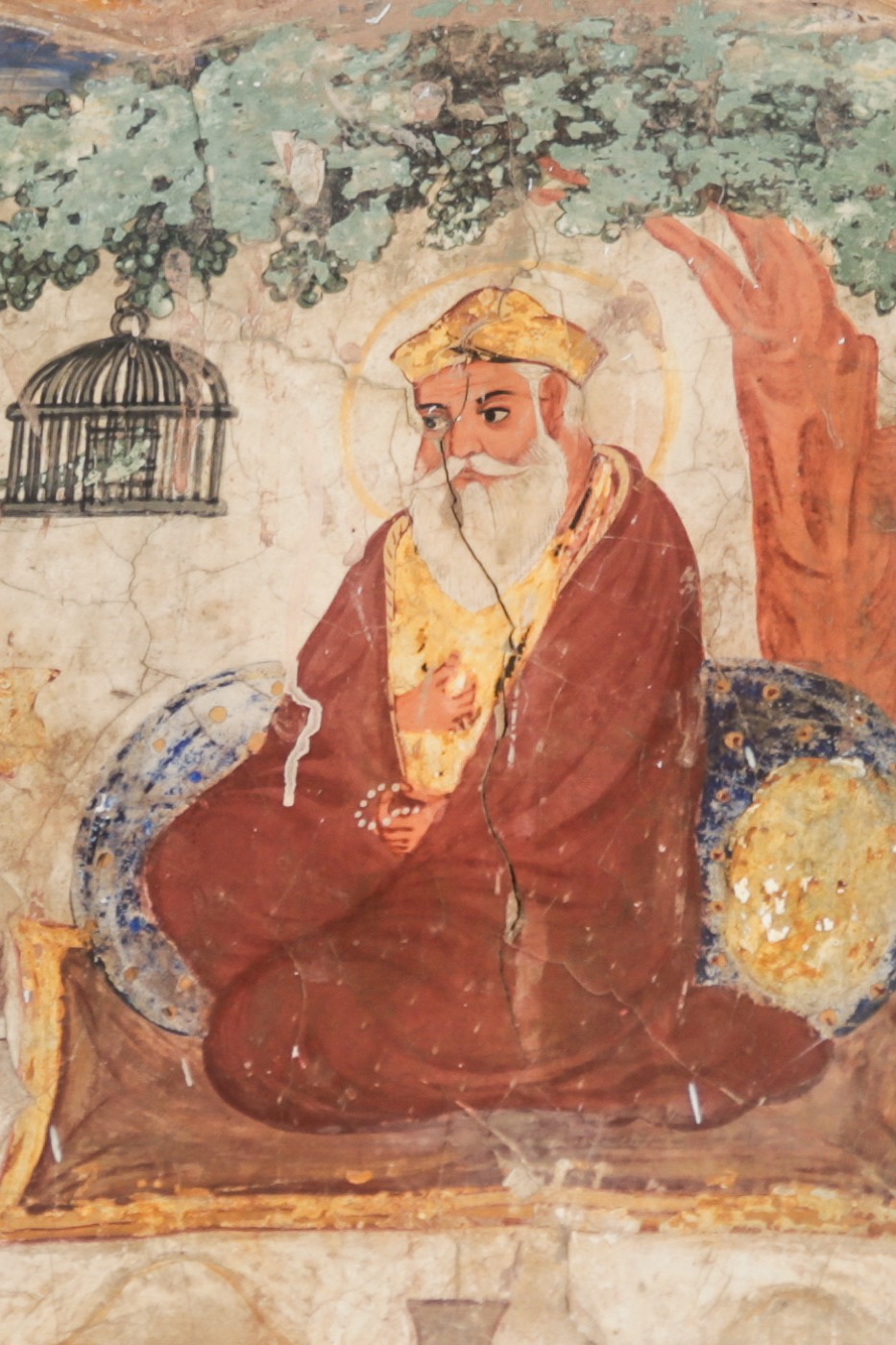
Born on 15 April 1469 at Talwandi Rai Bhoi, later renamed Nankana Sahib in his honour, Guru Nanak Dev Ji's teachings gave rise to Sikhism. As a young man he worked as an accountant at a grain store in Sultanpur Lodhi, close to his sister Bebe Nanaki, and Sikh tradition holds that he vanished into the nearby Kali Bein river for three days and returned transformed, uttering the words that would define his mission for the rest of his life.
An early story, the Sacha Sauda, tells how his father gave him money to strike a profitable trade, and the young Nanak spent it instead feeding a group of hungry ascetics, calling it "the true bargain," a parable of value measured in compassion rather than coin that Sikhs still tell children today. Soon after, he set out with a lifelong companion, the Muslim rebab player Bhai Mardana, and together they carried his teaching of one formless God, equality regardless of caste or creed, honest living and selfless service across the subcontinent and beyond, roughly 28,000 kilometres on foot across four continents by most estimates.
Sikh tradition holds that he made four great journeys, or udasis, over some two decades, south to Sri Lanka, north into Tibet, east across India, and west to Mecca and Baghdad, debating scholars, yogis and clerics of every faith he met along the way. He returned to Punjab and settled at Kartarpur, on the banks of the Ravi, where he farmed the land himself and ran a community kitchen open to all, the first Langar.
Guru Nanak Dev Ji passed away at Kartarpur on 22 September 1539, choosing as his successor not either of his own sons but a devoted disciple, Bhai Lehna, whom he renamed Guru Angad and installed as the second Guru, establishing from the very start that Sikh leadership would pass by merit and readiness, not by bloodline. It set every principle, one God, equality, honest work, seva and langar, that the nine Gurus who followed him would spend the next two centuries building into a faith.
Na koi Hindu, na koi Musalman.There is neither Hindu nor Muslim, only humanity, Guru Nanak Dev Ji
After nearly two decades of travel, Guru Nanak Dev Ji founded Kartarpur, the Abode of the Creator, on the west bank of the Ravi. There he lived out his last 18 years not as a wandering preacher but as a farmer, tilling the soil himself and running a community kitchen, the Langar, open to anyone regardless of caste, faith or status.
It was at Kartarpur that his teaching settled into three practical pillars still recited by Sikhs today: Naam Japna, remembering God, Kirat Karni, earning an honest living through one's own labour, and Vand Chakna, sharing what one has with others. Rather than retreat into asceticism, he showed by daily example that farming, family life and spiritual devotion belonged together, a deliberate break from the wandering renunciate holy men common in the region at the time.
Kartarpur set the template for everything that followed: worship, physical work and shared food treated as equally sacred. The town sits just across the border in present-day Pakistan, and the original shrine was rebuilt more than once after the Ravi repeatedly changed course and flooded the site over the centuries. The Kartarpur Corridor, a roughly four kilometre visa-free passage opened in November 2019 by the governments of India and Pakistan, now lets Sikh pilgrims from India visit Gurdwara Darbar Sahib Kartarpur directly, the first time in over seventy years that the birthplace of the faith and its founder's final resting place have both been reachable without a passport.
Guru Arjan Dev Ji, the fifth Guru, had built the Golden Temple at Amritsar, its foundation stone laid in 1588 by the Muslim Sufi saint Mian Mir at the Guru's own invitation, and in 1604 he compiled the Adi Granth, gathering the hymns of the first five Gurus together with the writings of Hindu Bhagats and Muslim Sufis, Baba Farid among them, into a single scripture, the core of what would become the Guru Granth Sahib Ji.
In his own memoir, the Tuzk-i-Jahangiri, the Mughal emperor Jahangir wrote that he had long wished "to put a stop to this vain affair," alarmed by the Guru's growing following among both "simple-hearted Hindus" and Muslims. The pretext arrived when Jahangir's own son, the rebel prince Khusrau Mirza, passed through Punjab in 1606 fleeing his father, and Guru Arjan Dev Ji offered him nothing more than customary courtesy and blessing. Jahangir had the Guru arrested on a charge of aiding rebellion, imposed a crushing fine of two lakh rupees, and demanded that verses deemed offensive to Hindus and Muslims be struck from the Adi Granth. Guru Arjan Dev Ji refused to alter a single word.
Over five days in the Lahore heat of late May 1606, he was tortured on the orders of the governor Murtaza Khan: seated on a burning iron plate while boiling water and hot sand were poured over his body, then finally led, blistered and dying, to bathe in the Ravi River, from which he did not return. Sikh tradition holds that he bore it all without complaint, a serenity later generations distilled into the phrase "Tera bhana meetha laage," Sweet is Thy will, O Lord.
He became Sikhism's first martyr, and his death permanently changed the character of the faith that followed him. His young son and successor, Guru Hargobind Ji, was installed as the sixth Guru within days and would respond by taking up arms for the first time in Sikh history, a transformation that began the very next entry in this timeline.
Tera bhana meetha laage.Sweet is Thy will, O Lord, words tradition attributes to Guru Arjan Dev Ji
Days after becoming the sixth Guru, the eleven year old Guru Hargobind Ji responded to his father's martyrdom by wearing two swords at his investiture, one for Miri, temporal authority, and one for Piri, spiritual authority, in a ceremony conducted by the elder Sikh Baba Buddha Ji, who had likewise anointed each of the Gurus before him. It was a declaration that faith and worldly responsibility were not opposites, and that the Sikh community would defend itself rather than simply endure whatever came next.
He began keeping a personal bodyguard and a small standing force, encouraged Sikhs to take up hunting, wrestling and weapons training alongside prayer, and built a fort at Amritsar called Lohgarh, the Fort of Iron, to defend the town his father had built around the Golden Temple.
That same year he built the Akal Takht, the Throne of the Timeless One, directly facing the Golden Temple in Amritsar, as the seat of Sikh temporal authority, and unlike any Guru before or after him, he held court there seated on a raised throne, hearing both spiritual matters and the everyday disputes, grievances and political affairs of his growing community. It remains the highest seat of Sikh political and community decision making today, and it is from its steps that the Panth's collective voice has been declared ever since, exactly as Guru Hargobind Ji intended when he built it.
Guru Hargobind Ji built a small standing army and fought four defensive battles against Mughal forces during his Guruship, but he is remembered just as much for how he left prison as for how he fought. The exact reason for his imprisonment remains debated, some accounts point to an unpaid fine inherited from his father's persecution, others to continued scheming by Chandu Shah, the Lahore official widely blamed for instigating Guru Arjan Dev Ji's arrest, and still others to simple preventive caution as the Guru's following and small army grew. Whatever the cause, Jahangir had him confined at Gwalior Fort for a period, and when the emperor finally agreed to free him, the Guru refused to leave unless 52 imprisoned Hindu princes held alongside him were freed too.
Jahangir, expecting to limit the release, agreed that only those who could hold onto the Guru's cloak while exiting could go free, so Guru Hargobind Ji had a special cloak made with 52 long tassels, and all 52 princes walked out beside him in the autumn of 1619. Sikhs still mark the day as Bandi Chhor Divas, the day of the release of the prisoners, celebrated alongside Diwali with the Golden Temple illuminated exactly as it is at Diwali itself.
In the years that followed, relations with the Mughal court soured further under Jahangir's successor Shah Jahan, and Guru Hargobind Ji fought a series of defensive battles against local Mughal commanders, at Amritsar in 1621 and later near Kartarpur in 1634 among them, each time repelling forces sent against him. The fighting eventually forced him to move the seat of the Guruship away from the plains entirely, to the safer, easily defended town of Kiratpur in the Sivalik hills, a relocation to the hill country that set the stage for Anandpur Sahib and the events of the next Guru generation.
A delegation of Kashmiri Pandits, led by Pandit Kirpa Ram and facing forced conversion to Islam under the emperor Aurangzeb, travelled to Anandpur Sahib in 1675 to ask the ninth Guru for help. As Guru Tegh Bahadur Ji sat in thought over how to respond, Sikh tradition holds that his nine year old son asked what troubled him, and, on hearing the dilemma, said simply that no one was more worthy of such a sacrifice than his own father. The Guru chose to confront the emperor himself, and set out for Delhi.
He was arrested near Agra and brought to Delhi, where he was imprisoned in an iron cage and given a stark choice: convert to Islam, perform a miracle to prove his faith, or die. Three of his companions who refused alongside him were executed first, in an apparent effort to break his resolve: Bhai Mati Das was sawn in half, Bhai Sati Das was wrapped in cotton and burned alive, and Bhai Dyala Ji was boiled in a cauldron. None recanted. While imprisoned and awaiting his own end, Guru Tegh Bahadur Ji composed several shabads on detachment and mortality that are preserved in the Guru Granth Sahib Ji today.
On 11 November 1675, he was publicly beheaded in Chandni Chowk after refusing to convert or perform a miracle to save himself, on the site where Gurdwara Sis Ganj Sahib now stands. He gave his life defending the religious freedom of a faith that was not his own, earning him the title Hind di Chadar, the Shield of India.
His head was carried over 300 kilometres to Anandpur Sahib by a devoted follower, Bhai Jaita, and delivered to his young son, who would become the tenth Guru, while his headless body was secretly retrieved by Bhai Lakhi Shah Vanjara, a Delhi merchant who cremated it inside his own house at night and then burned the house down around it rather than risk discovery, the site of which is now Gurdwara Rakab Ganj Sahib.
Bal chhutkio bandhan pare, kachhoo bidh nahi paavat.My strength is gone and I am bound in chains, yet I see no way to escape, Guru Tegh Bahadur Ji, composed in his Delhi prison cell
At just nineteen, Guru Gobind Singh Ji fought his first battle near Paonta Sahib, a town he had settled at the invitation of local hill chiefs on the banks of the Yamuna, against a coalition of Sivalik Hill rajas led by Raja Bhim Chand of Bilaspur, who had grown alarmed at the Guru's fortifications and swelling ranks of armed followers back at Anandpur. Vastly outnumbered, his small force, which included Sikh volunteers and Pathan mercenaries, held the field through a full day of fighting and won.
Not every hired Pathan stayed loyal when the fighting began, several deserted rather than fight fellow Muslims allied with the hill rajas, but a Sufi pir named Budhu Shah, who had personally introduced those Pathans to the Guru, brought his own sons, disciples and followers to fight in their place. Two of Pir Budhu Shah's sons were killed at Bhangani, and Guru Gobind Singh Ji later sent him, in gratitude, one of his own combs and a lock of his hair, relics the Pir's descendants preserved for generations, a quiet but lasting record of Muslim and Sikh solidarity forged in that single day of battle.
Bhangani proved that the Guru's community could organise and fight as a disciplined force, a lesson that shaped everything he built over the following decade, culminating eleven years later in the founding of the Khalsa.
1469 – 1708 · hand to hand
Two hundred and thirty-nine years. Ten teachers. One unbroken message, passed hand to hand, until it was placed, forever, into a book.
1469–1539
Founded Sikhism, established the Langar.
1504–1552
Standardised the Gurmukhi script, promoted literacy for all.
1479–1574
Abolished caste discrimination at langar, introduced Anand Karaj.
1534–1581
Founded Amritsar, composed the four Lavaan.
1563–1606
Built the Golden Temple, compiled the Adi Granth, the first Sikh martyr.
1595–1644
First to take up arms, built the Akal Takht, freed with 52 prisoners (Bandi Chhor).
1630–1661
Established large herbal medicine hospitals.
1656–1664
Became Guru at age five, died serving smallpox patients in Delhi.
1621–1675
Martyred in Delhi protecting Kashmiri Hindus' right to worship, "Hind di Chaddar."
1666–1708
Founded the Khalsa on Baisakhi 1699, declared Guru Granth Sahib Ji the eternal Guru.
1699 – 1849
A faith becomes an army, a confederacy of warrior chiefs becomes a kingdom, and then, within a decade of one man's death, it's gone.
On Baisakhi Day, 30 March 1699, before a gathering of tens of thousands at Anandpur Sahib, Guru Gobind Singh Ji stood with a drawn sword and asked the crowd: "Who will give their head for their faith?" One by one, five men stepped forward from the frightened silence. He baptised them with Amrit; then, in an act of astonishing humility, they baptised him in turn. From that day, Sikh men took the name Singh (Lion) and women Kaur (Princess), and every initiated Sikh carries the five Ks: Kesh (uncut hair), Kara (steel bracelet), Kanga (wooden comb), Kachera (cotton shorts) and Kirpan (ceremonial sword).
The five who stepped forward, remembered ever after as the Panj Pyare, the Five Beloved Ones, were deliberately drawn from across India and from castes usually kept far apart: Bhai Daya Singh, a Khatri trader from Lahore, Bhai Dharam Singh, a Jat farmer from Delhi, Bhai Himmat Singh, a water-carrier from Jagannath Puri, Bhai Mohkam Singh, a calico printer from Dwarka, and Bhai Sahib Singh, a barber from Bidar in the Deccan. That a Guru would ask a barber and a trader to drink from the very same vessel was itself the point.
The Amrit was prepared in an iron bowl, stirred with a double-edged sword, the khanda, while five sacred hymns were recited over it. Guru Gobind Singh Ji's wife, Mata Sahib Kaur, added sugar crystals to the mixture, said afterward to have given the Khalsa both sweetness and steel, so that strength would never curdle into cruelty. Every Sikh who was baptised that day, regardless of the caste they were born into, drank from the same bowl and took the same surname, dissolving centuries of caste hierarchy in a single ceremony.
It transformed Sikhism permanently: from a following defined by belief alone into a visible, disciplined and casteless community bound by shared appearance, shared greeting, "Vaheguru ji ka Khalsa, Vaheguru ji ki Fateh", and shared readiness to defend the faith openly rather than in hiding. Within decades that same community would fight off Mughal governors, Afghan invaders and, eventually, build an empire of its own.
Vaheguru ji ka Khalsa, Vaheguru ji ki Fateh.The Khalsa belongs to God, victory belongs to God, greeting established at the founding of the Khalsa
Alarmed by the newly baptised Khalsa gathering strength at Anandpur Sahib, a coalition of Sivalik Hill rajas and, later, Mughal forces laid siege to the fortified town repeatedly across the early 1700s. Guru Gobind Singh Ji had ringed the town with five small forts, Anandgarh, Keshgarh, Lohgarh, Fatehgarh and Holgarh, and his small garrison held out for years through blockade, starvation and repeated assault, at times reduced to eating leaves and tree bark as supplies ran out.
Unable to break through, the hill rajas eventually appealed to the emperor Aurangzeb himself, who sent imperial troops under commanders including Wazir Khan of Sirhind to reinforce the siege. By the final months of 1704 the town was starving, and its remaining defenders begged the Guru to accept a way out.
In December 1704, besieging commanders swore on the Quran and the cow, an oath meant to be unbreakable to Muslims and Hindus alike, that the Guru's family would be allowed to leave Anandpur safely if they abandoned it. Guru Gobind Singh Ji evacuated on that promise, and it was broken within hours: the retreating column was attacked crossing the swollen Sarsa River at night, scattering the Guru's family, and destroying much of his baggage, manuscripts and personal library in the flood, into the events that followed at Chamkaur and Sirhind.
Separated from most of his family after the Sarsa crossing, Guru Gobind Singh Ji took shelter in a small mud fortress, a local landlord's fortified haveli, at Chamkaur with fewer than 40 men, including his two elder sons, Sahibzada Ajit Singh, about seventeen, and Sahibzada Jujhar Singh, about thirteen. A Mughal force numbering in the thousands surrounded them.
Rather than wait to be overrun, the defenders chose to sally out in small groups of five at a time, deliberately echoing the number of the original Panj Pyare, fighting to the death against overwhelming odds so that each group could inflict maximum damage before falling. Ajit Singh led one of the first groups out and was killed; his younger brother Jujhar Singh insisted on following him and died the same way, over three days both of the Guru's elder sons and almost every companion in the fortress fell.
When only a handful of defenders remained, the surviving members of the Panj Pyare invoked their collective authority as the voice of the Khalsa itself and ordered Guru Gobind Singh Ji to leave and live, arguing that the Panth needed its Guru far more than this one fortress needed defending. Under cover of night, disguised and accompanied by only a few companions, he escaped to continue the struggle. Sikhs still mark the event every December as one of the most sacrificial in their history, and the site is now home to Gurdwara Katalgarh Sahib.
Guru Gobind Singh Ji's two younger sons, Sahibzada Zorawar Singh, aged nine, and Sahibzada Fateh Singh, aged seven, were separated from their father at the Sarsa and taken in, briefly, by a family cook named Gangu, who then betrayed their location to the authorities near Sirhind in hope of a reward. They were captured along with their grandmother, Mata Gujri Ji, and held for several freezing December nights in an open tower known ever since as the Thanda Burj, the Cold Tower, before being brought before Wazir Khan, the Mughal governor of Sirhind.
Offered wealth, land and their lives if they simply renounced their faith and converted to Islam, both boys, not yet ten years old, refused, echoing the same principle their grandfather Guru Tegh Bahadur Ji had died defending a generation earlier. One local Mughal noble, Nawab Sher Mohammad Khan of nearby Malerkotla, is remembered for publicly objecting to the killing of children as contrary to his own faith, though his protest did not stop the execution.
According to Sikh tradition, the two were bricked into a wall on the orders of Wazir Khan's court on 26 December 1704, and when the wall did not kill them outright, they were put to the sword. Their grandmother, Mata Gujri Ji, died in the same tower that same day upon hearing the news of her grandsons' deaths. The site is now Fatehgarh Sahib, one of Sikhism's most visited gurdwaras, drawing enormous crowds every December during the Shaheedi Jor Mela, and their sacrifice, at ages most would call childhood, is remembered as one of the most solemn weeks in the entire Sikh calendar.
The forty in question had abandoned Guru Gobind Singh Ji during the darkest days of the siege of Anandpur, convinced he could not survive, and had signed a bedava, a formal letter disavowing him as their Guru, before returning home. There, their own wives and mothers, ashamed of what they had done, refused to accept them back and pushed them to make it right. It was one of those women, Mai Bhago, a Jat farmer's daughter and a skilled fighter herself, who organised and personally led the forty men back to find the Guru, determined to fight even if he would not forgive them.
A year after Chamkaur, on 29 December 1705, Wazir Khan's pursuing Mughal army caught up with them at Khidrana, a shallow pool in the Malwa desert. The forty, with Mai Bhago fighting in their front line, held off the much larger Mughal force long enough for Guru Gobind Singh Ji, watching from nearby high ground, to bring his own men into the fight and force the Mughal army to withdraw. Nearly all forty died on the field; only their badly wounded leader, Mahan Singh, still clung to life when the Guru reached him afterward, and as he lay dying in the Guru's arms, Guru Gobind Singh Ji tore up the bedava with his own hands, formally forgiving them all before Mahan Singh passed away.
The Guru declared the forty Chali Mukte, the Forty Liberated Ones, and the pool at Khidrana was renamed Muktsar, the Pool of Liberation, in their memory, a name the city that grew up around it still carries today. Mai Bhago survived the battle and went on to serve as one of Guru Gobind Singh Ji's personal bodyguards for the rest of his life, remembered ever since as one of Sikh history's most celebrated women warriors.
After Chamkaur, Guru Gobind Singh Ji wrote directly to the Mughal emperor Aurangzeb, a 111 verse Persian poem known as the Zafarnama, the Epistle of Victory, later preserved as part of the Dasam Granth. Despite everything he had just lost, the letter is composed with total moral authority, not pleading, but accusing Aurangzeb and his commanders by name of breaking their sworn oaths at Anandpur and Sirhind, and questioning how a ruler who claimed to govern by faith and justice could preside over such betrayals.
Its most famous couplet, "Chun kar az hama heelate dar guzasht, halal ast burdan ba shamsheer dast," holds that when all other means have failed, it is righteous to raise the sword, a line still cited today as the clearest statement of Sikh just-war principle: the sword only as an absolute last resort. The letter was carried south into the Deccan and delivered personally into Aurangzeb's hands by Bhai Daya Singh, one of the original Panj Pyare baptised at Anandpur six years earlier.
Aurangzeb, by most historical accounts, was deeply shaken by the letter and wrote back inviting the Guru to meet him in the Deccan, reportedly out of genuine remorse for what had been done in his name. Guru Gobind Singh Ji set out for that meeting, but the elderly emperor died at Ahmednagar in 1707 before it could take place, leaving the reconciliation the letter had seemed to promise forever unfinished.
After Aurangzeb's death touched off a war of succession among his sons, Guru Gobind Singh Ji lent his support to Prince Muazzam, who won the throne as Emperor Bahadur Shah I and, for a time, travelled south with the new emperor on comparatively friendly terms. It was at Nanded, in present-day Maharashtra, that this uneasy peace ended: in October 1708, two Pathans, sent, most historians believe, on the orders of Wazir Khan of Sirhind, attacked the Guru while he rested, stabbing him before he himself cut down his assailant.
The wound was treated and appeared at first to be healing, but reopened days later, and Guru Gobind Singh Ji, knowing his end was now near, made a decision that would define Sikhism permanently. On 6 October 1708, he gathered his Sikhs, placed five coins and a coconut before the Guru Granth Sahib Ji, and bowed before it himself.
Rather than name a human successor, he declared the scripture itself the eternal, living Guru, Guru Granth, Guru Panth. There would be no eleventh Guru; the Sikh community would look to its scripture and to itself for guidance from that day forward, a decision unique among the world's major faiths. The site of that declaration, Nanded, is today the Takht Sachkhand Sri Hazur Sahib, one of the five Takhts of Sikh temporal authority.
Sab Sikhan ko hukam hai, Guru Manyo Granth.All Sikhs are commanded to accept the Granth as Guru, Guru Gobind Singh Ji, Nanded, 1708
Born Lachman Dev and known for years as an ascetic called Madho Das, Banda Singh Bahadur was living as a hermit in the Deccan when he met Guru Gobind Singh Ji at Nanded and was transformed by the encounter. The Guru gave him five arrows, a battle drum, a banner and a hukamnama, a letter of authority, and sent him north into Punjab to rally the Khalsa and hold Wazir Khan and Sirhind to account for the deaths of the Chhote Sahibzade.
On 22 May 1710, Banda's Sikh army crushed the Mughal governor's forces at Chappar Chiri, killing Wazir Khan himself in the battle, and days later captured and razed Sirhind entirely. He proclaimed Sikh rule on 27 May 1710, striking coins and a state seal in the name of the Gurus, the first independent Sikh government in history. In the territory he controlled he went further still, abolishing the zamindari landlord system and granting ownership of the land directly to the peasants who actually worked it, a social reform startling for its time.
His fledgling state held only a few years before a massive Mughal force cornered his army at Gurdas Nangal and starved it into surrender after a siege lasting close to a year. Banda Singh Bahadur was captured in December 1715, paraded to Delhi in chains along with hundreds of his surviving companions, and executed there in June 1716 after prolonged torture, refusing to the end to renounce his faith or his cause. He had proven, for the first time in Sikh history, that Sikh sovereignty was possible, and every Sikh state that followed, the misls and eventually Maharaja Ranjit Singh's empire, built on the precedent he set.
By the time of Banda Singh Bahadur's execution in 1716, Sikh forces had already proven that they could govern as well as fight, but the years that followed brought some of the harshest persecution in Sikh history. Mughal governors, especially Zakariya Khan in Lahore, placed bounties on Sikh heads and hunted them relentlessly, forcing surviving Khalsa fighters into the forests and marshes of the Lakhi Jungle, where they survived by adopting hit and run guerrilla tactics rather than open battle.
Out of that hardship, Sikh leaders including Nawab Kapur Singh organised the scattered fighters into a more disciplined structure in 1748: the Budha Dal, made up of older, seasoned veterans responsible for preaching and shrine upkeep, and the Taruna Dal, younger fighters who carried the actual combat. Over the decades that followed, Khalsa forces reorganised further into misls, sovereign warrior confederacies, eventually twelve in number, among them the Ahluwalia, Bhangi, Kanhaiya, Ramgarhia, Nakai, Phulkian and Sukerchakia misls, each governing its own territory almost like a small republic.
Collectively known as the Dal Khalsa, the misls answered to no single ruler. Instead, twice a year, at Baisakhi and Diwali, the whole Panth gathered at the Akal Takht in Amritsar as the Sarbat Khalsa, an assembly that passed collective resolutions, or Gurmatas, in the name of the Guru rather than any individual chief. For over eighty years this confederacy held the frontier, repelling repeated invasions by the Afghan king Ahmad Shah Durrani, until it controlled almost all of Punjab between its member chiefs. It was the young chief of the Sukerchakia misl, Ranjit Singh, who began welding the misls into a single kingdom, capturing Lahore in 1799.
As Sikh resistance rebuilt through the misls, the Lahore official Lakhpat Rai, driven partly by a personal vendetta after his brother was killed in an earlier skirmish with Sikh raiders, launched a determined campaign with the governor's backing to crush the community for good. Sikh forces, along with non-combatant families travelling with them, were cornered in the marshy Kahnuwan Chhamb near the Beas River, trapped without food or open ground to manoeuvre, and over several weeks in the spring of 1746 roughly 10,000 Sikh men, women and children were killed, many drowning as they tried to escape across the flooded river.
Prisoners taken alive were marched to Lahore and publicly executed at the city's Nakhas Chowk, the horse market, a site later renamed Shaheed Ganj, the Place of Martyrs, in their memory. In the aftermath, the word Guru was banned in Lahore, gurdwaras were demolished and Sikh scripture burned, an attempt to erase the community rather than merely defeat it. Sikhs remember it as the Chhota Ghallughara, the Lesser Holocaust, to distinguish it from the larger tragedy that followed sixteen years later, and, as with every earlier attempt to destroy the Khalsa outright, the persecution did not hold: within a few years Sikh forces had rebuilt and were raiding Lahore's own countryside in turn.
The Afghan king Ahmad Shah Abdali, founder of the Durrani Empire, invaded India repeatedly between 1748 and 1767, at least eight times by most counts, largely to plunder Delhi and secure Punjab as a frontier buffer, and Punjab bore the weight of every one of them. Sikh misls, meanwhile, had become notorious for harassing his supply columns and, most famously, intercepting convoys carrying captured Hindu women being taken back to Afghanistan as slaves, freeing them and escorting them safely home, a practice that earned the Khalsa deep respect across Punjab's countryside even as it enraged Abdali.
On 5 and 6 February 1762, his forces caught a column of Sikhs, most of them non-combatant families being escorted to safety by misl chiefs, moving across open ground near Kup and Barnala and killed an estimated 25,000 to 30,000 of them, close to a third of the entire Sikh population at the time.
Sikhs remember it as the Vadda Ghallughara, the Greater Holocaust. Barely two months later, on 10 April 1762, Abdali marched on Amritsar and had the Golden Temple packed with gunpowder and blown apart, an act he repeated again in 1764. Each time, Sikh forces rebuilt the shrine within months, a defiance that became, for the Khalsa, as much a part of the story as the destruction itself, and Abdali, despite winning nearly every battle he fought in Punjab, was never able to hold the province for long: within two decades of his death in 1772, the very misls he had tried to annihilate controlled almost the whole of it.
While armies rose and fell, Punjab's countryside was singing. Sufi poets writing in Punjabi, using the Perso-Arabic Shahmukhi script rather than Gurmukhi, gave the language some of its most enduring verse. Shah Hussain (1538 to 1599), the earliest of the great Punjabi Sufi poets, wrote short, ecstatic kafis and became so close to a young Hindu Brahmin named Madho Lal that the two are buried together in Lahore under the joint name Madho Lal Hussain, their shrine still host to the annual Mela Chiraghan, the Festival of Lamps, one of Punjab's oldest surviving folk festivals. Sultan Bahu (1628 to 1691) followed with his own austere verse form, the abyat, each quatrain ending on the single Arabic word "Hu," He, a wandering ascetic's constant meditation on God.
Bulleh Shah (1680 to 1757), a mystic poet of Kasur, deepened that tradition further, and scandalised his own high-born Syed family by taking a lower-caste weaver, Shah Inayat Qadiri, as his spiritual master, a deliberate rejection of caste hierarchy that cost him socially but shaped his most famous verses, kafis that prized direct, ecstatic devotion over rigid ritual and asked, in lines still quoted across Punjab today, "Bulleya, ki jaana main kaun," Bulleh, I do not even know who I am, a meditation on identity dissolving before the divine.
In 1766, Waris Shah, trained at the same town of Kasur, completed Heer Ranjha, his retelling of Punjab's most famous folk tragedy, the doomed love of Heer and her beloved Ranjha, torn apart by family honour and social convention. It remains the most celebrated long poem in the Punjabi language to this day, still sung, quoted and taught on both sides of the border, proof that Punjab's story was never written by kings and Gurus alone, but just as often by the poets, mystics and lovers who lived alongside them.
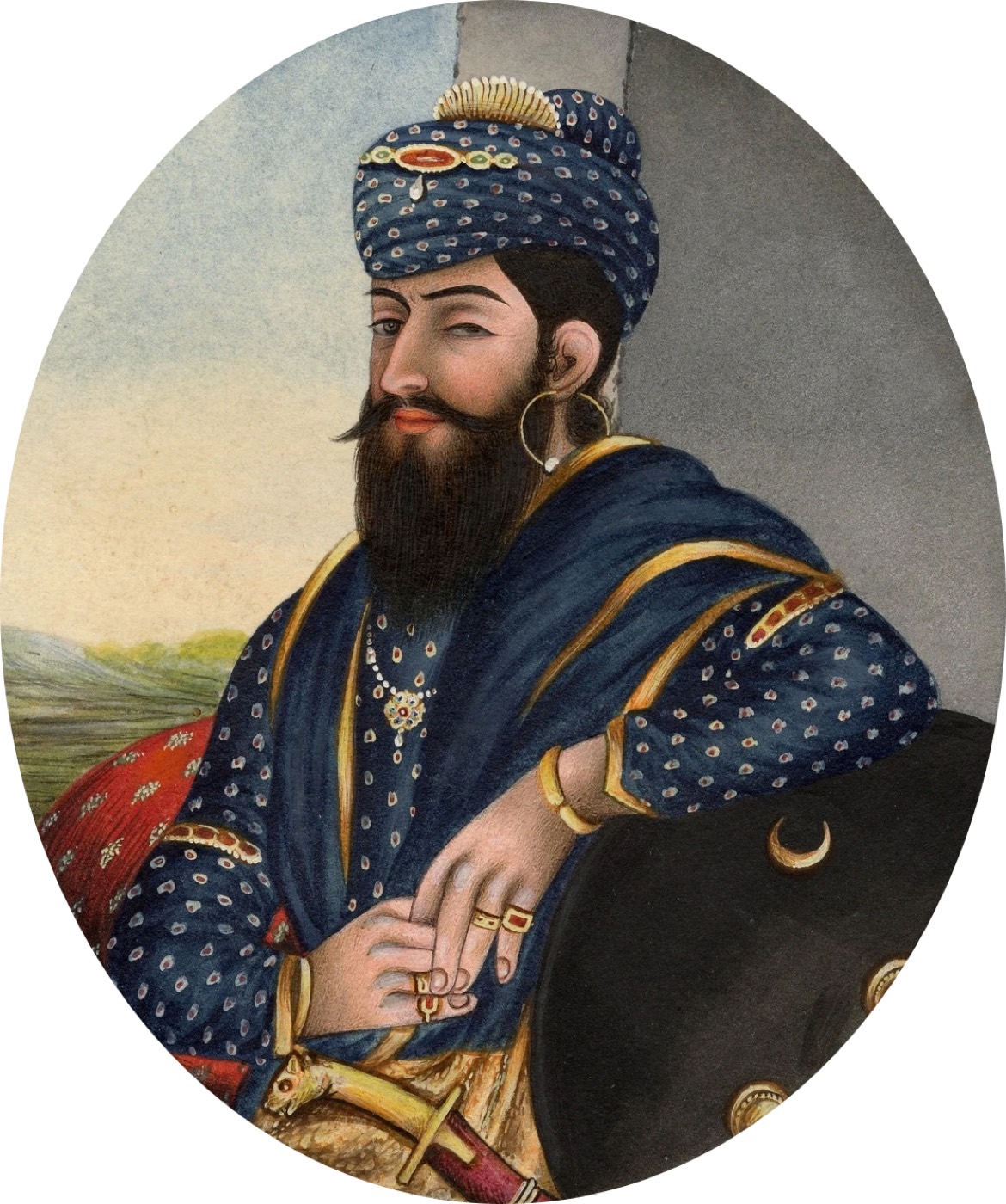
Born in 1780 and blinded in one eye by smallpox as a child, Ranjit Singh became chief of the Sukerchakia misl at just twelve years old after his father's death, and was guided through his early years by his formidable mother-in-law, Sada Kaur of the Kanhaiya misl, whose own troops and political counsel proved decisive in his rise. At eighteen, he marched on Lahore in July 1799, joined by Sada Kaur's forces, at the invitation of the city's own residents, who were weary of the feuding Bhangi misl chiefs, Chet Singh, Mohar Singh and Sahib Singh, who then held it and could not agree on how to defend it.
The city surrendered without a real fight on 7 July 1799, its gates opened from within, and Ranjit Singh made it his capital. Unlike the Afghan and Persian armies that had sacked Lahore in living memory, he deliberately spared the city from plunder and treated its residents, Muslim, Hindu and Sikh alike, with visible restraint, a decision that won him lasting goodwill and made the transition strikingly bloodless for a change of power in Punjab.
It was the moment a talented young warlord began turning a loose confederacy of misls into a single kingdom, absorbing rival Sikh chiefs one by one over the following years, by alliance, marriage or, when necessary, force, until within a generation the entire patchwork of misl territories had become one unified state.
On Baisakhi Day 1801, Sahib Singh Bedi, a descendant of Guru Nanak Dev Ji, applied the ceremonial saffron mark to Ranjit Singh's forehead at Lahore Fort and proclaimed him Maharaja of Punjab, before a full gathering of the Sikh court and generous distribution of alms to the city's poor. He was twenty years old.
True to Sikh tradition, he refused a throne or crown and struck coins in the name of the Guru rather than his own, the Nanakshahi rupee, inscribed with the phrase Deg Tegh Fateh, victory of the cauldron and the sword, meaning charity and military strength granted together by the grace of Guru Nanak and Guru Gobind Singh. He called his government the Sarkar Khalsaji, the Government of the Khalsa, deliberately styling his rule as a trust held on behalf of the Panth rather than a personal crown.
It marked the formal beginning of the Sikh Empire, which would grow, over the next four decades, into one of the most powerful states in Asia, and it was from around this period that Ranjit Singh became known across Punjab and beyond by the title history remembers him by, Sher-e-Punjab, the Lion of Punjab.
Under Maharaja Ranjit Singh, the "Lion of Punjab", the Sikh Empire became one of the most powerful states in Asia, its capital at Lahore commanding territory from Kashmir to Sindh and from the Khyber Pass to the Sutlej. Hari Singh Nalwa served as Commander-in-Chief, pushing the frontier to the edge of Afghanistan. The rule was strikingly secular for its era: Hindus and Muslims held senior posts throughout the empire alongside Sikhs, and it became the first state on the subcontinent to abolish the death penalty. Shah Shuja Durrani, the deposed Afghan king given refuge at Lahore, is said to have surrendered the legendary Koh-i-Noor diamond to Ranjit Singh in 1813 in exchange for the Maharaja's protection, Ranjit Singh wore it as an armband at court ever after.
His Khalsa Army was rebuilt along modern lines: from 1822, French officers Jean-François Allard and Jean-Baptiste Ventura, both veterans of Napoleon's campaigns, retrained the cavalry and infantry, and the elite Fauj-i-Khas brigade drilled alongside Italian, American and British officers stationed in Lahore. By the 1830s it was one of the most disciplined armies in Asia, and for four decades it held the Khyber Pass, keeping foreign armies out of Punjab.
At its height the empire stretched across some 200,000 square miles, absorbing Multan in 1818, Kashmir in 1819 and Peshawar in 1834, and its splendour and religious tolerance struck nearly every foreign visitor who reached Lahore. When a British officer at an 1831 diplomatic meeting jokingly asked why the Maharaja had only one working eye, his Muslim foreign minister, Fakir Azizuddin, is recorded as replying that the Maharaja's single eye shone with such brilliance that he had never dared look upon what the other might have held. It was Ranjit Singh, too, who funded the gold plating and marble that gave the Golden Temple in Amritsar the name the world knows it by today.
In 2020 a BBC World Service poll voted him the "Greatest Leader of All Time," a striking legacy for a self-taught, one-eyed farm boy from a minor misl who built, through equal parts warfare, diplomacy and religious tolerance, one of the last great pre-colonial Indian empires, and the only one to hold the Khyber Pass shut from the Indian side in the whole of recorded history.
The splendour and luminosity of his single eye is so much that I have never dared to look at his other eye.Fakir Azizuddin, Ranjit Singh's foreign minister, on the Maharaja's missing eye
Born in Gujranwala in 1791 and orphaned as a boy, Hari Singh Nalwa joined Maharaja Ranjit Singh's court as a young man and rose swiftly through the ranks to become one of his most trusted generals and, at various times, governor of both Kashmir and Peshawar. As commander-in-chief of the Khalsa Army, he led campaigns that pushed the Sikh Empire's frontier past Kashmir and Peshawar to Jamrud, right at the mouth of the Khyber Pass, the historic invasion route into India used by every conqueror from Alexander onward. For the first time in centuries, that door was closed from the Indian side rather than the Afghan one.
His reputation on the frontier grew so fearsome that, according to Punjabi and Pashtun folklore alike, mothers on the Afghan side of the border invoked his name for generations afterward to quiet frightened children, a measure of how deeply his presence was felt across the region he had conquered.
He died on 30 April 1837 defending the fort he had built at Jamrud against a far larger Afghan army led by Akbar Khan, son of the Kabul ruler Dost Mohammad Khan. Badly wounded, he kept issuing orders until his death, and his officers concealed the news until Sikh reinforcements arrived, Afghan commanders feared his reputation enough that the fort held even after he had already died, a final testament to the psychological hold he had over the frontier he spent his life defending.
Maharaja Ranjit Singh died on 27 June 1839 after a series of strokes, leaving no single figure with his authority to hold the empire together. What followed was a decade the Sikh Empire never recovered from: four different rulers took the throne in barely six years, several murdered in outright succession disputes at the Lahore court. His eldest son, Kharak Singh, succeeded him but died suspiciously within a year, and Kharak Singh's own son, Nau Nihal Singh, was killed the very same day in an apparent gate collapse while returning from his father's funeral. Sher Singh took the throne next in 1841 and was assassinated in 1843 by rival court nobles, the Sandhawalia sardars, along with the powerful minister Dhian Singh.
By 1843, the throne had passed to Ranjit Singh's youngest son, Maharaja Duleep Singh, a boy of just five years old, with his mother, Maharani Jind Kaur, acting as regent amid a court riddled with factional intrigue. The Khalsa Army, still one of the largest and best drilled forces in Asia, found itself with no ruler strong enough to control it, and increasingly a political force in its own right, its regimental panchayats, elected army councils, dictating pay demands and military policy independently of the fractured Lahore court. That instability, more than any external enemy, opened the door to the war that came next.
By December 1845, the leaderless but still formidable Khalsa Army crossed the Sutlej into East India Company territory, opening the First Anglo-Sikh War. Sikh gunners and infantry fought the Company to a bloody standstill at Mudki on 18 December, then came close to a decisive win two days later at Ferozeshah, where both sides suffered devastating casualties and the British commanders themselves later admitted they had expected defeat.
Historians have long pointed to treachery at the very top of the Khalsa's own command as a decisive factor: the army's commander, Tej Singh, and its wazir, Lal Singh, both maintained secret contact with the British and are widely believed to have deliberately withheld reserves and mismanaged the army's positions at critical moments, undermining a force that, soldier for soldier, was more than a match for the Company's troops.
The war was settled at Sobraon on 10 February 1846, where the Khalsa Army, pinned against the flooded Sutlej River with an inadequate bridge of boats behind it, fought through a devastating final assault before being overwhelmed, with heavy losses among soldiers trying to escape across the river itself. British officers who fought there described it afterward as among the bloodiest battles of their careers. The Treaty of Lahore that followed stripped Punjab of Kashmir and the Jalandhar Doab and placed a British Resident at Lahore, and under a separate arrangement, the Treaty of Amritsar, Kashmir itself was sold to Gulab Singh, a Dogra noble who had served in Ranjit Singh's court, for 7.5 million rupees, founding the princely state that would govern it for the following century.
Peace lasted barely two years. In April 1848, a revolt by Diwan Mulraj, the governor of Multan, escalated into a full Sikh uprising against British control. The war's bloodiest fighting came at Chillianwala on 13 January 1849, where the Khalsa Army captured British guns and regimental colours in one of the costliest battles the East India Company ever fought on Indian soil, British losses alone came to around 602 killed, over 1,650 wounded and more than a hundred missing, a result so alarming in London that the Company's commander was recalled in disgrace.
It was decided a month later, on 21 February 1849, at Gujrat, nicknamed "the battle of the guns", where a sustained artillery bombardment finally broke Sikh resistance and the Khalsa Army lost dozens of guns in the retreat that followed. What remained of the army formally laid down its arms at Rawalpindi on 14 March 1849, and British officers who witnessed the surrender wrote afterward of hardened Khalsa soldiers weeping openly as they stacked the swords and muskets they had carried through a generation of victories.
On 29 March 1849, the eleven-year-old Maharaja Duleep Singh signed away his kingdom under a new Treaty of Lahore, and Punjab, the last independent Indian state, passed into British hands, ending forty years of Sikh sovereignty. Under the treaty's terms, the Koh-i-Noor diamond was formally surrendered to the British Crown; it was presented to Queen Victoria in 1850 and shown to the public that year at the Great Exhibition in London. Duleep Singh himself was later taken to Britain as a teenager, where he lived out much of his life before dying in Paris in 1893, the final Maharaja of a kingdom that, within a decade of his father's death, had ceased to exist.
1857 – 1947
The years that tested Punjab hardest, reform, sacrifice, tragedy, and the ones every Punjabi family still carries.
Barely eight years after annexation, Baba Ram Singh, born in 1816 to a carpenter's family at Bhaini Sahib in Ludhiana district, founded the Namdhari movement on Baisakhi Day, 12 April 1857, the same week the great uprising against British rule broke out elsewhere in India. He called Sikhs back to simple, austere living, all-white homespun clothing, a wool rosary, strict daily discipline and a deliberate, total boycott of British courts, schools, titles, textiles and postal services decades before Gandhi's non-cooperation movement borrowed the same tactic. Followers became known as Kukas for the way they cried out and swayed in trembling ecstasy during their devotional singing.
Ram Singh's reforms cut directly against the social order of the day. In June 1863, at the village of Khote in Ferozepur district, he introduced the Anand Karaj, a short, inexpensive Sikh wedding ceremony performed by ordinary Sikhs rather than costly Brahmin priests, and set a minimum marriage age of 16 for girls and 18 for boys, confronting child marriage head-on more than four decades before the Anand Marriage Act finally gave the ceremony legal recognition in 1909.
The movement's total rejection of British authority hardened into open confrontation over cow protection, a cause many Kukas felt colonial policy trampled. On 14 and 15 January 1872, roughly 200 Kukas led by Hira Singh and Lehna Singh raided the fort at Malaudh and then attacked the princely town of Malerkotla itself, and were overpowered after losses on both sides. The district's Deputy Commissioner, John Lambert Cowan, had dozens of the captured men tied in front of cannon and blown apart without any trial at all, 50 on 17 January and 16 more the next day, 66 in total, among them a twelve-year-old boy, Bishan Singh. Cowan ignored an order from his own superiors, received mid-execution, to avoid hasty action, and falsely telegraphed Lahore that calm had been restored. The scale and lawlessness of the killings alarmed the British government itself: an official inquiry followed, and Cowan was dismissed from service for exceeding his authority.
Baba Ram Singh was exiled to Rangoon on 18 January 1872 and held there as a state prisoner for nearly fourteen years. He was reported to have died on 29 November 1885, though the circumstances were murky enough that many of his followers never accepted it, and Namdhari Sikhs today still hold, as an article of faith, that their Guru did not die but withdrew from view and will return. The community he founded, still centred on Bhaini Sahib, remains active in Punjab to this day, and the 66 Kuka martyrs are formally remembered every January at a memorial in Malerkotla.
After annexation, Christian missionary schools and printing presses spread rapidly across Punjab, and in 1853 the exiled boy-Maharaja Duleep Singh converted to Christianity in England. Then, in the early months of 1873, several Sikh students at the Amritsar Mission School themselves declared an intention to convert, a moment that alarmed Sikh elders enough to act. On 1 October 1873, a group led by Thakur Singh Sandhawalia and Giani Gian Singh founded the Singh Sabha of Amritsar to defend and revive the faith from within.
A second, more assertive body followed in Lahore in 1879, and the two developed sharply different characters. The Amritsar Singh Sabha, led largely by aristocratic families and hereditary custodians, favoured a gentler, Sanatan view that saw Sikhism as closely bound to broader Hindu tradition. The Lahore Singh Sabha, dominated by educated middle class reformers, pushed a harder line known as Tat Khalsa, the "real Khalsa", insisting Sikhism was a wholly separate faith with its own scripture, discipline and Five Ks, and adopting the blunt slogan "Ham Hindu Nahin", we are not Hindus. Within a generation, well over a hundred Singh Sabhas were active across Punjab, loosely coordinated after 1902 by the Chief Khalsa Diwan in Amritsar.
Their mission went far beyond theology: reclaiming and standardising Sikh scripture and ritual, fighting illiteracy, publishing in Punjabi and Gurmukhi rather than Persian or Urdu, and opening schools and colleges across the province, most notably Khalsa College, Amritsar, founded in 1892 with backing from both the colonial government and Sikh princely states, still one of the region's most important institutions today. Scholars and poets who emerged from this milieu, Bhai Vir Singh chief among them, gave the reform its literary voice, retelling Sikh history and scripture in accessible modern Punjabi for a new generation of readers.
It was this patient, unglamorous work of publishing, schooling and self-definition, carried out decades before independence was even imaginable, that gave the Akali and Gurdwara reform movements of the 1920s their intellectual foundation, and without it, the confident, modern Sikh institutions of the twentieth century would have had nothing to build on.
Saragarhi was little more than a single fortified signal tower on the Samana Range in the North-West Frontier Province, a relay post whose only job was to pass heliograph messages between two larger British forts, Lockhart and Gulistan, that could not see one another directly. On 12 September 1897, an army of Afghan and Orakzai tribesmen, estimated at 10,000 or more, surrounded it. Inside stood 21 soldiers of the 36th Sikhs, under Havildar Ishar Singh, and a single non-combatant camp follower who chose to stay and fight alongside them.
The tribal leaders offered the garrison safe passage if they surrendered the post. Havildar Ishar Singh refused outright. As the outer wall was breached, he ordered his men back to the inner defences and personally stayed to cover their retreat, dying in the doorway he held alone. One by one the defenders fell, but not before inflicting devastating losses, estimates drawn from later accounts range from 180 to as many as 600 tribesmen killed or wounded, a startling ratio against a garrison of 21.
Sepoy Gurmukh Singh, the post's signaller, kept sending updates to Fort Lockhart by heliograph through the entire battle, reportedly requesting permission to finally set down his signalling equipment and pick up his rifle only once the position was clearly lost. He held the last corner of the burning post alone and is said to have killed around 20 more attackers before the building was set alight around him, going down still calling the Sikh battle cry, "Bole So Nihal, Sat Sri Akal," Whoever utters this shall be fulfilled, for truth is the Timeless One. Every one of the 21 died; not one surrendered, and not one broke.
News of the stand reached the British Parliament within days, and all 21 defenders were posthumously awarded the Indian Order of Merit, the highest gallantry decoration then open to Indian soldiers under British command, an extraordinary collective honour for men mostly recruited from ordinary Majha and Malwa farming villages. Their names are still read aloud in gurdwaras and regimental messes every 12 September, marked as Saragarhi Day, and the battle remains part of the curriculum at British and Indian military academies alike as one of history's great outnumbered last stands, still studied for the same reason Thermopylae is: not the odds, but the discipline that held against them.
Bole So Nihal, Sat Sri Akal.The Sikh battle cry, said to have been called by Sepoy Gurmukh Singh, the last defender of Saragarhi
By the early 1900s, tens of thousands of Punjabis had already emigrated abroad, many recruited to build the railways of British East Africa, thousands more sailing to Canada and the United States to work timber mills, farms and the Canadian Pacific Railway. Facing open racial discrimination, exclusion from citizenship and increasingly restrictive immigration laws in their new homes, Punjabi migrants on the West Coast of North America founded the Ghadar, "Mutiny", Party in Astoria, Oregon on 15 July 1913, with the Amritsar-born mill worker Sohan Singh Bhakna as its first president and the scholar-agitator Lala Har Dayal as its intellectual driving force. Its newspaper, also called Ghadar, was smuggled back into Punjab by the thousand, calling openly for armed revolution to end British rule.
In May 1914, the chartered steamship Komagata Maru, arranged by the Sikh businessman Gurdit Singh specifically to test Canada's exclusionary immigration laws, arrived in Vancouver's harbour carrying 376 passengers, almost all of them Punjabi, most Sikh. Canadian officials refused nearly all of them entry under the "continuous journey" regulation, a law written with no direct sailing route from India in mind precisely so it could exclude Indian migrants without naming them, and after a two-month standoff in the harbour, watched by crowds on the Vancouver shore, the ship was forced back out to sea with most of its passengers still aboard.
It did not sail home quietly. On its return to Calcutta in September 1914, colonial police tried to force the passengers onto a train bound for Punjab; when they refused and attempted instead to march into the city, police opened fire at Budge Budge, killing at least nineteen. Gurdit Singh himself evaded capture for six years before surrendering at Mahatma Gandhi's own request in 1920 and served five years in prison. The Canadian government issued a formal apology for the incident in the House of Commons in 2016.
The humiliation of the Komagata Maru hardened Ghadar's resolve into open insurrection. Thousands of Ghadarites, including the young Kartar Singh Sarabha, barely nineteen years old, sailed back to Punjab in 1914 and 1915 hoping to spark a coordinated mutiny within British Indian Army regiments, a plot betrayed from inside its own ranks by an informer before it could begin. Sarabha and several others were hanged at Lahore Central Jail in November 1915, one of the first times Punjabis abroad had organised, funded and attempted an armed rising for independence rather than simply appealing for reform, and it remains a defining, still-commemorated chapter in the story of the Punjabi diaspora in North America.
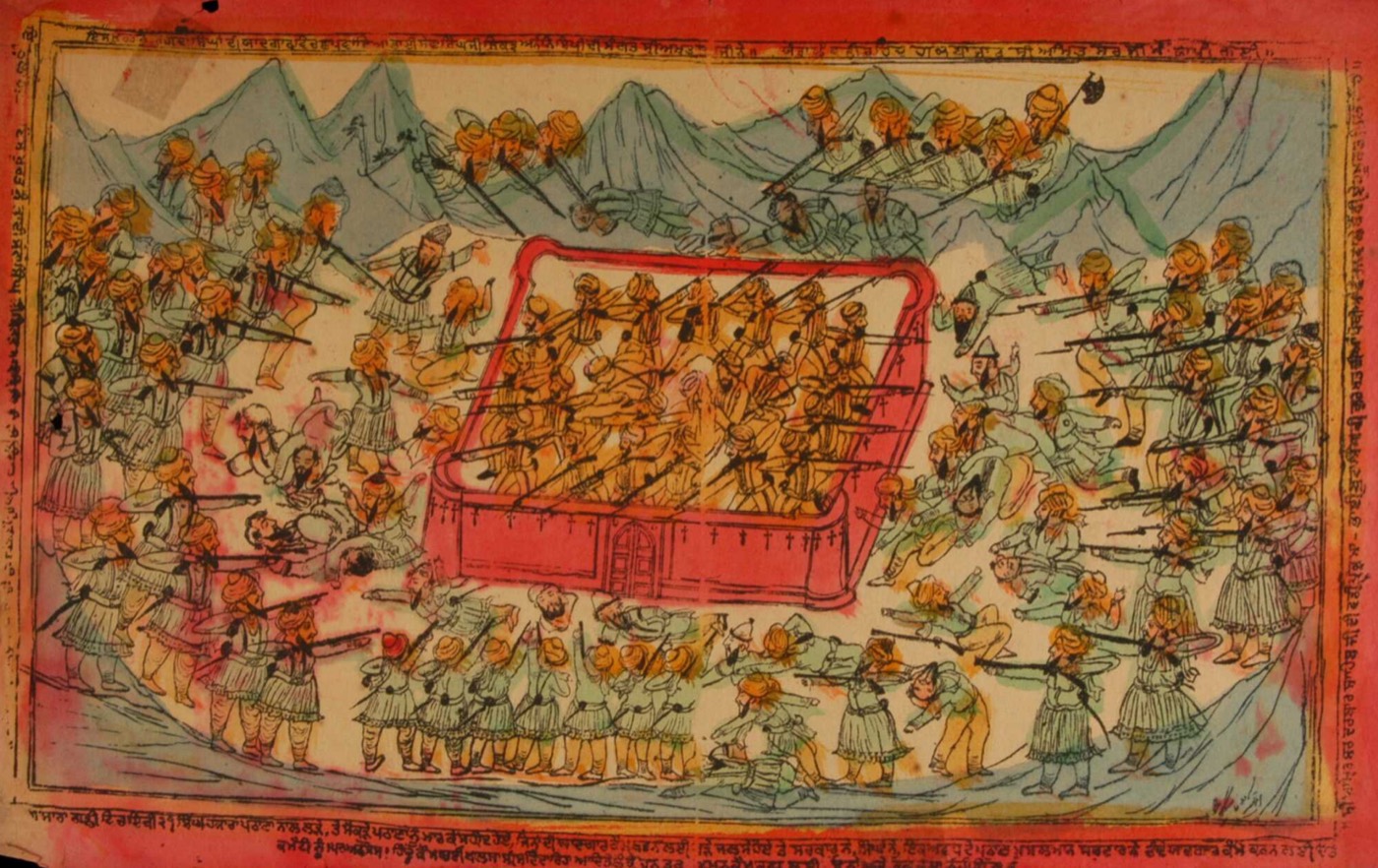
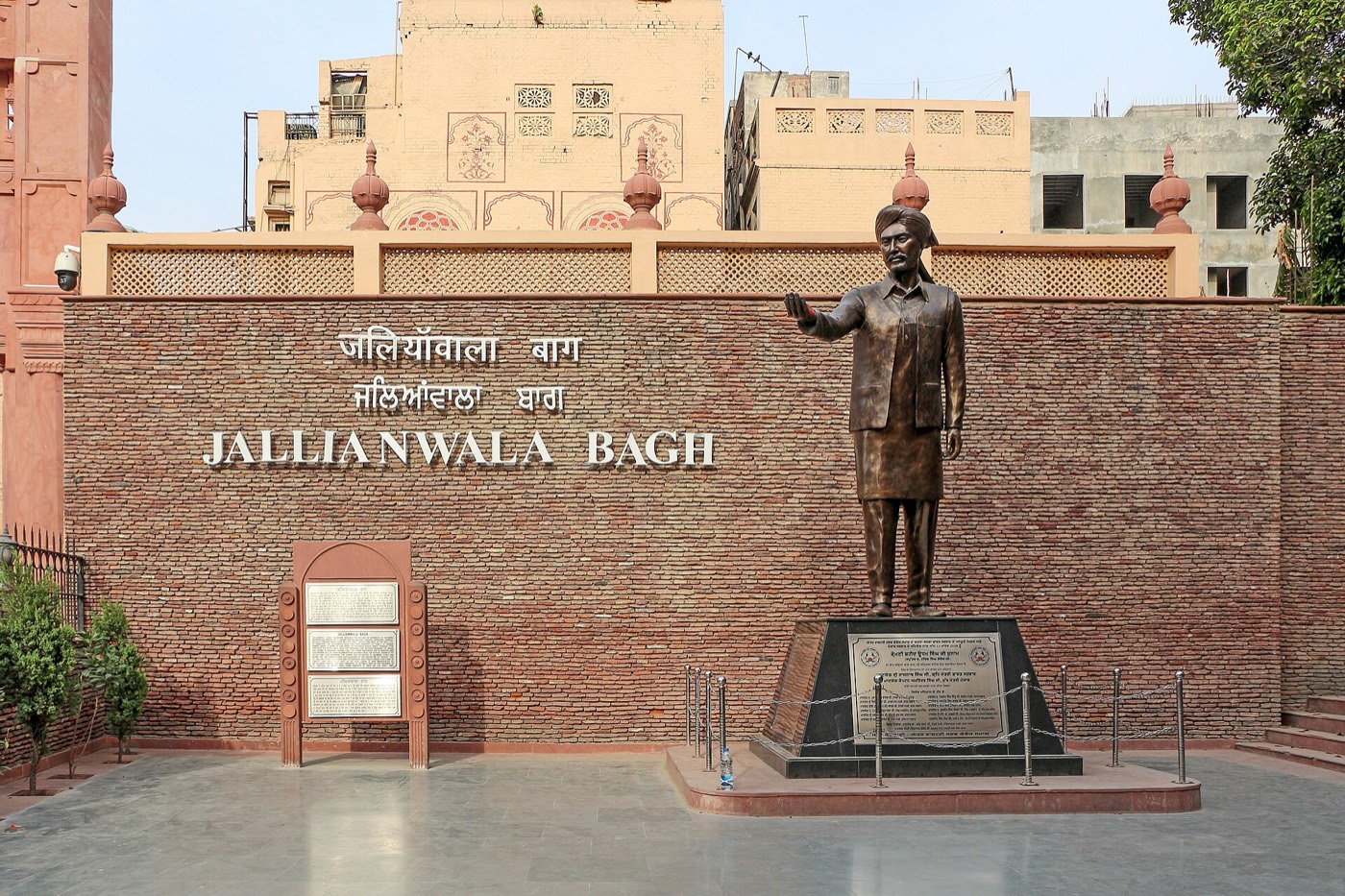
Tensions in Amritsar had been rising for weeks under the wartime Rowlatt Act, which let the colonial government imprison suspects without trial, and the arrest and deportation of two local leaders had already triggered rioting and a handful of deaths in the city days earlier. On the afternoon of 13 April 1919, Baisakhi Day, several thousand people, many of them pilgrims and traders visiting for the festival who had little connection to the unrest, gathered in Jallianwala Bagh, a walled garden with only a few narrow exits, for a public meeting.
Brigadier-General Reginald Dyer marched around 50 riflemen to the main entrance, blocked it with his armoured cars too wide to pass through, and, without warning or any order for the crowd to disperse, ordered his troops to open fire directly into the packed garden. They fired for about ten minutes, roughly 1,650 rounds, deliberately aiming toward the narrow gates where people were trying to flee, until ammunition ran low. Many died jumping into a deep well in the garden trying to escape the bullets. The colonial government's own official toll was 379 dead; the Indian National Congress's independent inquiry, and most historians since, put the true figure at well over 1,000, with several times that number wounded.
Dyer never expressed remorse, telling the Hunter Commission set up to investigate that he had fired to produce a "moral effect" on the whole of Punjab, not merely to disperse the gathering in front of him. Michael O'Dwyer, the Lieutenant Governor of Punjab who had approved martial law across the province and backed Dyer's account afterward, was widely held equally responsible. The massacre provoked international outrage: Rabindranath Tagore renounced his British knighthood in protest, and Winston Churchill, then a British cabinet minister, condemned it in Parliament as "a monstrous event." Dyer was formally censured and forced to resign his command, but faced no criminal charge, and a sympathetic public fund raised in Britain afterward awarded him a substantial sum on his retirement.
The wound stayed open for twenty-one years. On 13 March 1940, Udham Singh, a survivor of the massacre who had himself been wounded that day, shot and killed Michael O'Dwyer at a meeting in Caxton Hall, London, and was hanged for it later that year, a name still honoured across Punjab as the massacre's avenger. Jallianwala Bagh itself is remembered as the single event that turned Indian public opinion decisively from petitioning the Raj for reform to demanding its complete end, and Mahatma Gandhi's first nationwide non-cooperation campaign followed within a year.
Jallianwala Bagh accelerated a reform already building inside Sikh religious institutions. Punjab's gurdwaras, including many of its holiest sites, were at the time controlled by hereditary custodians, mahants, who often ran them as personal property under British patronage, treating shrine income and land as their own and, in some cases, indulging in practices flatly at odds with Sikh teaching. On 15 November 1920, reformers gathered at the Akal Takht itself to form the Shiromani Gurdwara Parbandhak Committee, the SGPC, to wrest management of Sikh shrines away from these custodians and their colonial patrons and hand it to an elected Sikh body.
The campaign turned bloody within months. On 20 February 1921, a reformist jatha arrived peacefully at Gurdwara Janam Asthan in Nankana Sahib, birthplace of Guru Nanak, to press the resident mahant, Narain Das, to reform his management. Narain Das had prepared for exactly this: he had fortified the gurdwara, armed hired gunmen, and stockpiled firearms and vessels of boiling oil in advance. His men opened fire on the unarmed reformers and then attacked them with swords and clubs as they tried to flee, killing well over a hundred, some accounts put the toll close to 200, in what Sikhs came to call the Saka Nankana Sahib. Colonial authorities, unable to ignore the scale of the killing, handed the shrine's keys to a Sikh committee within a day.
Nationwide outrage followed, and the reform movement, organised under the banner of the Shiromani Akali Dal, pressed on through further confrontation. At the Guru ka Bagh shrine near Amritsar in 1922, hundreds of unarmed Akali volunteers allowed themselves to be beaten unconscious by police, one disciplined column after another, without raising a hand in resistance, a display of non-violent endurance that drew international press coverage and won the movement wide public sympathy. A more militant offshoot, the Babbar Akalis, pursued the same cause through armed action against corrupt informers and officials, and several of its members were later hanged for it in the Lahore conspiracy trials that followed. In 1923, the deposition of Maharaja Ripudaman Singh of the princely state of Nabha, a sympathiser of the Akali cause, triggered the Jaito Morcha, a relay of protest marches, jathas, that continued for roughly two years and drew volunteers from across India before the interrupted Akhand Path at Gurdwara Gangsar, Jaito, was finally allowed to conclude.
The Sikh Gurdwaras Act, passed by the Punjab Legislative Council in 1925, finally transferred legal control of Punjab's historic shrines from private mahants to the elected SGPC. It remains, a century later, the single most consequential piece of Sikh institutional reform of the modern era: the SGPC it created still governs the Golden Temple and thousands of other gurdwaras worldwide, elected by the Sikh community itself rather than inherited or appointed from outside it.
Born in September 1907 to a family of Arya Samaj freedom fighters in Banga, Lyallpur district, Bhagat Singh grew up steeped in the cause of independence: his father, Kishan Singh, and his uncles Ajit Singh and Swaran Singh had all been jailed in 1907 for opposing the Colonization Bill, a punitive land tax on Punjab's farmers, and Ajit Singh went on to spend 37 years in political exile abroad rather than give up the fight. He left college to join the underground Hindustan Socialist Republican Association, drawn to a fiercely secular, socialist vision of a free India rather than any religious framing of the struggle, and read voraciously, Marx, Bakunin and European revolutionary history among his influences, while still in his early twenties.
In December 1928, in retaliation for a police baton charge that had fatally injured the veteran nationalist leader Lala Lajpat Rai weeks earlier, Bhagat Singh and fellow HSRA members Rajguru and Chandrashekhar Azad shot and killed the British police officer J. P. Saunders in Lahore, having mistaken him for the more senior officer who had actually ordered the charge. Then, on 8 April 1929, Bhagat Singh and Batukeshwar Dutt threw two low-intensity bombs into the Central Legislative Assembly in Delhi, deliberately built to make noise rather than kill, to protest repressive new public safety and labour laws, and showered the chamber with leaflets declaring, "It takes a loud voice to make the deaf hear," before shouting "Inquilab Zindabad," Long Live the Revolution, and surrendering to police on the spot, precisely so their trial could become a public platform for the cause.
Held through the Lahore Conspiracy Case that followed, Bhagat Singh and his fellow prisoners went on repeated hunger strikes demanding better treatment for political prisoners; a fellow HSRA member, Jatin Das, died on the 63rd day of his own hunger strike in September 1929, his funeral drawing enormous crowds and becoming a nationalist rallying point in its own right. Bhagat Singh used the months of trial to write prolifically on secularism, atheism and revolution, arguing in his prison essays that the struggle was for a just social order, not merely a change of rulers.
Bhagat Singh, Rajguru and Sukhdev were sentenced to death and hanged inside Lahore Central Jail on 23 March 1931, their execution quietly moved forward by roughly eleven hours ahead of the scheduled date to avoid the mass protests and unrest authorities feared would greet it. He was twenty-three years old. His atheism, socialism and calm, unflinching acceptance of death made him one of the most widely admired figures in the entire subcontinent's history, revered across every religious community in Punjab and India alike, and 23 March is still observed nationally as Shaheedi Diwas, Martyrs' Day, in his memory.
Inquilab Zindabad.Long live the revolution, shouted by Bhagat Singh after the 1929 Assembly bombing
On 14 and 15 August 1947, India and Pakistan were born as independent nations, but the actual border through Punjab was not announced until two days later, on 17 August. It had been drawn in barely five weeks by Sir Cyril Radcliffe, a British lawyer who had never before set foot in India and who left the country the moment his line was published, never to return. His commission split canal networks, railway lines, farmland and, in Lahore and Amritsar's case, cities that had shared a common life for centuries, straight down the middle, placing Lahore, the historic seat of the Sikh Empire, on the Pakistani side, and Amritsar, home of the Golden Temple, on the Indian one.
What followed was the largest forced migration in recorded history: an estimated 10 to 14 million people crossed the new border in both directions within months, on foot, by bullock cart and packed onto trains, as Hindus and Sikhs fled west to east and Muslims fled east to west, each community suddenly a vulnerable minority on the wrong side of a line none of them had drawn. Punjab bore the worst of the violence of any region on the subcontinent: armed bands ambushed refugee columns and stopped trains at gunpoint, killing everyone aboard, so that "trains of death," carriages arriving at their destination station with no living passenger left, became one of Partition's most horrifying and recurring images.
Estimates of the dead vary enormously and will likely never be settled, from roughly 200,000 in the most conservative reckonings to a widely cited 1 to 2 million across the whole of Punjab and beyond, alongside a further horror rarely spoken of for decades afterward: historians estimate that 75,000 to 100,000 women were abducted, raped, or forced into marriage or conversion across the divided province, on both sides of the new border, in the chaos of that single summer and autumn. Entire villages that had stood for generations were abandoned overnight, and refugee camps holding hundreds of thousands sprang up on both sides of the line almost immediately.
There is barely a Punjabi family, anywhere in the world, that does not carry some part of this history, a grandparent who walked, a home that was left behind, a name of a village on the other side of a border that can no longer be visited. It remains the deepest wound in Punjab's story, and also, in the decades that followed, the reason the region's diaspora spans as many countries as it does today.
1960s – 1970s
Partition had cut the breadbasket in two. Within a generation, the half that remained fed a nation.
From the moment India became independent in August 1947, the Shiromani Akali Dal, under its veteran president Master Tara Singh, pressed a long campaign known as the Punjabi Suba movement, for a state organised on linguistic lines with Punjabi in Gurmukhi script as its official language, exactly as most other Indian states had already been reorganised by the mid-1950s under the States Reorganisation Act of 1956. Punjab, uniquely, was left out of that reorganisation, and the demand dragged on for the better part of two decades and several rounds of arrests and protest.
The government banned public slogans in support of Punjabi Suba in April 1955, and when Master Tara Singh led a defiant protest march that May, he was arrested, launching a sustained agitation. Leadership of the campaign passed increasingly to Sant Fateh Singh, who escalated the pressure dramatically: in December 1960, he began an open-ended fast unto death, refusing all food for 22 days before finally breaking it on 9 January 1961, and by the Akali Dal's own count, some 57,129 people were arrested across Punjab during that single seven-month phase of the movement alone.
The Punjab Reorganisation Act finally came into effect on 1 November 1966, splitting the old, larger bilingual Punjab into three: a smaller, Punjabi-speaking Punjab, a new Hindi-speaking state of Haryana carved from its southern and eastern districts, and hill districts transferred to Himachal Pradesh, with the modernist planned city of Chandigarh, designed by Le Corbusier, built as a shared union territory capital serving both new states. The new, smaller Punjab that resulted, roughly a third the size of the pre-1966 state, is the Punjab the world recognises by that name today, and it was this compact, linguistically unified state that would go on, within just a few years, to lead the transformation of the next entry in this timeline.
Partition had cut Punjab's canal-irrigated breadbasket in two and left millions of refugees to rebuild from nothing on both sides of the new border, and through the 1950s and early 1960s independent India still relied heavily on foreign food aid, most of it shipped in under the American PL-480 programme, to feed itself. That changed faster, and more completely, than almost anyone predicted, and it changed in Punjab first.
The agronomist M. S. Swaminathan, working at the Indian Agricultural Research Institute in Delhi, had spent years searching for a way to break India's yield ceiling when he began collaborating in the early 1960s with the American plant scientist Norman Borlaug, whose dwarf, disease-resistant wheat varieties, bred in Mexico, produced far more grain per stalk without collapsing under its own weight. In 1966, the Indian government imported roughly 18,000 tonnes of these Mexican seed varieties, and Punjab's farmers, supported by the newly founded Punjab Agricultural University in Ludhiana, inaugurated by Jawaharlal Nehru in July 1962, and by locally bred high-yield strains such as Kalyan Sona, adopted them faster and more completely than any other Indian state.
The combination, high-yield seed, expanded canal irrigation and tubewells, chemical fertiliser and mechanised tractors and threshers, paired with government-guaranteed minimum support prices that gave farmers the confidence to invest, produced results that stunned agricultural economists worldwide. India's annual wheat crop rose from around 10 to 12 million tonnes in the mid-1960s to roughly 20 million tonnes by 1970, and Punjab, barely 1.5% of India's land area, was by then producing close to 70% of the nation's entire food-grain surplus. India, an importer of food since independence, declared itself self-sufficient in food grains by 1971, a change so dramatic that the USAID administrator William Gaud gave it a name that stuck worldwide when he called it, in a 1968 speech, the "Green Revolution."
The transformation earned Punjab its enduring title, the breadbasket of India, and it fed a nation of hundreds of millions through decades when famine still stalked much of the developing world elsewhere. It came at a real cost: decades of intensive tubewell irrigation and heavy fertiliser use have steadily lowered Punjab's water table and degraded its soil, a challenge the state's farmers and scientists, the same institutions that built the Green Revolution, are still working today to solve for the generation after them.
20th century onward
While farms and factories rebuilt a divided province, Punjab's poets, singers and volunteers kept building something else, a culture the whole world would eventually dance to.
Born in Gujranwala, now in Pakistani Punjab, in 1919, Amrita Pritam was already a published poet by her teens and became the first major woman writer in modern Punjabi literature. In 1947 she was living in Lahore, the city she loved, and was forced to flee to Delhi with her family as Partition tore the province apart around her. The following year, travelling from Dehradun to Delhi and pregnant with her son, she wrote her anguish directly onto a scrap of paper: "Ajj Aakhaan Waris Shah Nu," To Waris Shah, I Say Today, an anguished appeal to Waris Shah, the long-dead 18th century poet of Heer Ranjha, to rise from his grave and witness what had been done to the daughters of Punjab, invoking Heer's own grief as a stand-in for the violence inflicted on women during Partition. It remains, to this day, the single most famous poem written about the tragedy in any language.
In 1956, for her collection Sunehade, Messages, Amrita Pritam became the first woman ever to win the Sahitya Akademi Award, India's highest literary honour. She went on to write more than a hundred books of poetry, fiction and essays across six decades, including the novel Pinjar, The Skeleton, another unflinching account of a Partition-era abduction later adapted into a celebrated film, and she lived for nearly four decades in a devoted, unconventional partnership with the painter Imroz, who illustrated much of her later work, until her death in Delhi in 2005.
A generation later, Shiv Kumar Batalvi, born in 1936 near Batala, became Punjabi poetry's most romantic and tragic voice, writing verse soaked in longing, separation and the ache of love before it is ever fulfilled. His 1965 verse epic Loona, a retelling of the Puran Bhagat legend that reimagines its usual villain as a woman trapped and misunderstood by the world around her, won him the Sahitya Akademi Award in 1967 at just 31, still the youngest writer ever to receive it, and effectively created a new form of modern Punjabi kissa, or verse narrative.
He died in 1973 at only 36, his life cut short by the same intensity that fuelled his poetry, but his ghazals and long poems, above all "Birha Tu Sultan," Separation, You Are King, are still recited, set to music and sung across Punjab today, and between them, Amrita Pritam and Shiv Kumar Batalvi gave modern Punjabi literature its two defining voices of grief and longing in the very decades the province was trying to rebuild itself.
Ajj aakhaan Waris Shah nu, kiton kabraan vichon bol.Today, I call out to Waris Shah, speak from within your grave, Amrita Pritam, "Ajj Aakhaan Waris Shah Nu," 1948
Bhangra began centuries ago as a Punjabi harvest folk dance, danced by farmers to the beat of the dhol drum to celebrate a good wheat crop coming in at Baisakhi, its steps built around the swing of the sickle and the labour of the fields themselves. It crossed continents with the Punjabi diaspora, and it was in Britain in the 1980s that it truly transformed: British Punjabi artists and bands, Birmingham's Malkit Singh and Alaap among the best known, fused the traditional dhol beat with Western pop, disco and synthesizer production to create British Bhangra, a genre entirely its own, filling community halls and wedding stages across the UK's growing Punjabi communities.
That fusion kept crossing further outward. By 2003, the British Punjabi producer Panjabi MC's remix of "Mundian To Bach Ke," built over a sample of the Knight Rider theme and featuring the American rapper Jay-Z, became a genuine top 40 hit across Europe and the United States, one of the first times a Punjabi-language track reached mainstream Western radio on its own terms rather than as a novelty.
That crossover never really stopped, and it kept accelerating. In April 2023, the Punjabi singer and actor Diljit Dosanjh became the first Punjabi artist ever to perform at the Coachella Valley Music and Arts Festival in California, one of the biggest stages in global pop music, delivering an almost entirely Punjabi-language set in traditional dress and a turban, praying before he walked on stage, to a crowd that included stars from across the industry. It introduced millions of new listeners in a single afternoon to a sound, and a language, that began generations earlier in the wheat fields of rural Punjab, and it marked, alongside a wave of Punjabi and Punjabi-Canadian artists who followed him onto Western festival stages in the years after, Punjabi music's arrival as a genuinely global genre rather than a diaspora niche.
1984
We present this factually and without political comment, because it is part of the history every Punjabi carries.
In June 1984, the Indian Army entered the Golden Temple complex in Amritsar in a military action, Operation Blue Star, aimed at removing armed militants who had fortified themselves inside the shrine after a period of rising tension in Punjab. The action caused significant damage to the Akal Takht, later rebuilt by the SGPC, and resulted in the deaths of soldiers, militants and, by most accounts, a number of pilgrims and bystanders who were present in the complex at the time; exact casualty figures are still disputed among different accounts today.
On 31 October 1984, Prime Minister Indira Gandhi was assassinated by two of her own bodyguards. In the days that followed, organised violence broke out against Sikh communities in Delhi and a number of other Indian cities. Estimates of the death toll nationwide vary considerably by source, and the events were examined afterward by several official inquiries in the years that followed.
These events remain deeply painful for the community, and we share them here as part of the history every Punjabi carries, not as commentary, but as memory.
Today's Punjab is a non-political, community-first magazine. We record this chapter with care, not to assign blame, but so it is never forgotten.
1897 – Today
The five rivers gave way to every ocean. From the first ships to Vancouver to the gurdwaras of Southall, Punjab never stayed still, it just kept building community, wherever it landed.
Punjab's global diaspora began generations before Partition, in the very decade Saragarhi was fought. In 1897, Sikh soldiers of a British Indian Army regiment passed through Canada on their way home from Queen Victoria's Diamond Jubilee celebrations in London, and word of the country's land and opportunities travelled back to Punjab with them. Between 1903 and 1908, an estimated 5,000 to 6,000 Punjabis, most of them Sikhs, settled in British Columbia, working timber mills, farms and the Canadian Pacific Railway, while several thousand more crossed the border south into Washington, Oregon and California, labouring in lumber camps and, increasingly, on the farmland of the Central Valley.
They arrived to open hostility: Canada's 1908 "continuous journey" regulation and a string of similar American exclusion laws were written specifically to keep Indian migrants out, and Punjabi settlers on both sides of the border spent the following decades fighting, mostly through the courts and through organisations like the Ghadar Party, for the basic right to remain, to own land and, eventually, to become citizens at all; that fight would not be fully won in the United States until Congress passed the Luce-Celler Act in 1946.
At the same time, and for entirely different reasons, tens of thousands of Punjabis, again overwhelmingly Sikhs, were recruited under indentured contracts to build the roughly 930 kilometre Uganda Railway across British East Africa between 1896 and 1901, gruelling and dangerous work that cost close to 2,500 lives to disease, accident and, in its most notorious stretch, man-eating lions. By the time the line reached Lake Victoria in 1901, most surviving labourers returned home, but several thousand chose to stay on afterward as skilled tradesmen, shopkeepers, mechanics and civil servants across Kenya and Uganda, planting Sikh and Punjabi communities, and gurdwaras, that have thrived in East Africa for well over a century since.
After the Second World War, a new wave of Punjabi migration reshaped Britain. As citizens of Commonwealth countries, Punjabis had the legal right to live and work in the UK, and postwar Britain, rebuilding its industry and desperately short of labour, actively recruited it: thousands of Punjabis, many of them army veterans or their sons who had already served alongside British forces in the war, settled through the 1950s and 1960s in industrial towns like Southall, Birmingham, Wolverhampton and Gravesend, staffing foundries, textile mills, engineering works and the newly formed National Health Service.
Southall, in west London, became the emblematic example: at the R. Woolf's rubber factory there, around 90% of unskilled workers were Punjabi by the 1950s, and the community organised quickly to protect its own interests, founding the Indian Workers' Association in 1956 to fight for fair pay and safe conditions, a body that met, in its earliest days, inside the local Sikh temple itself before any purpose-built gurdwara existed. Gurdwaras opened first in ordinary terraced houses, and Southall's first dedicated Gurdwara Sri Guru Singh Sabha opened its doors in 1964, the community having by then grown large enough to build rather than borrow its place of worship.
Within a generation, Southall had grown into one of the largest Punjabi and Sikh communities anywhere outside India itself, its high street lined with Punjabi shops, sweet houses and gurdwaras, a pattern soon repeated in Wolverhampton, Birmingham and beyond, and echoed in the same decades by fast-growing Punjabi communities forming in Canada, the United States and Australia.
In April 1999, the 300th anniversary year of the founding of the Khalsa, Ravinder "Ravi" Singh, a Punjabi-born Sikh who had settled in Chalvey, near Slough, in the 1980s, drove two trucks of emergency supplies to the Albania-Kosovo border to help refugees fleeing the Kosovo War, struck by the scale of suffering he found there. On his return he founded Khalsa Aid from a small office in Slough, guided by the Sikh principle of Sarbat da Bhala, the wellbeing of all, regardless of race, religion or border, becoming one of the first genuinely cross-border Sikh humanitarian organisations of the modern era.
Since then, its volunteers have set up free langar kitchens and emergency relief on almost every continent, from Ukraine and Afghanistan to Australian bushfires, Caribbean hurricanes and floods across South Asia, serving whoever is in front of them without asking their faith, work that saw Khalsa Aid nominated for the Nobel Peace Prize in 2021, more than two decades after it began with two trucks and a handful of volunteers. It is, in a very real sense, Guru Nanak's original Langar at Kartarpur, five centuries old, still being served, just carried a great deal further from home.
Today, roughly 130 million Punjabis and people of Punjabi descent live on every continent on Earth, spanning speakers of Punjabi across dozens of countries far beyond Punjab's own roughly 30 million residents in India and Pakistan combined. The Sikh community that grew from the same soil, some 25 to 30 million people worldwide, has itself become a genuinely global one: Canada alone is home to close to 800,000 Sikhs, the largest Sikh population outside India and, proportionally, the highest concentration of Sikhs of any country on Earth; the United Kingdom counts over half a million; the United States several hundred thousand more; and smaller but deeply rooted communities thrive across Australia, Italy, Malaysia, the Gulf states, East Africa and beyond.
Wherever they have settled, from the first Sikh soldiers who passed through Canada in 1897, through the labourers of the Uganda Railway, the Ghadar revolutionaries of California, the factory workers of postwar Southall, and the professionals, students and entrepreneurs of every wave since, Punjabis have carried the same things with them: their language, their food, their music, their unmatched work ethic, and above all the seva tradition that runs in an unbroken line back to Guru Nanak's Langar at Kartarpur. Gurdwaras, temples, mosques and community halls now anchor Punjabi neighbourhoods on every inhabited continent, hosting the same free community kitchens that once fed a fifteenth century village on the banks of the Ravi.
It is, in the end, the same story this whole page has told, just scattered further and wider than any single Guru, empire or emperor could have imagined: a people repeatedly tested by conquest, partition and displacement who kept rebuilding, kept sharing what they had, and kept carrying Punjab with them, one langar hall, one gurdwara and one generation at a time, wherever in the world they landed.